

Later-in-Life Romance After Divorce in Women’s Fiction (Second Chances That Feel Real)

The moment she signs the papers, or finally stops waiting for the other shoe to drop, something shifts. Life isn’t over, it’s just different now, and that difference can be terrifying and strangely full of possibility.
That’s why later-in-life romance after divorce hits so hard in women’s fiction. The promise is simple: growth comes first, then love shows up as a powerful part of a fresh start (even when it isn’t the whole story). If you’re looking for books that tell the truth about grief, fear, awkward first dates, and rebuilding confidence, you’re in the right place.
In this post, we’ll talk about the story ingredients that make these romances feel real, the themes readers crave (identity, belonging, emotional safety), and how to tell when you’re reading women’s fiction vs romance. We’ll also point to a few 2026 buzzy picks, including Once and Again by Rebecca Serle, You & Me and You & Me and You & Me by Josie Lloyd and Emlyn Rees, and The Love Lyric by Kristina Forest.
If you want extra reading paths along the way, start with best books starting over after divorce, why divorce novels feel like therapy, why second-chance love stories feel like therapy, midlife reinvention stories, what is women’s fiction, women’s fiction themes and tropes, women’s fiction vs romance, strong independent female protagonists, and beach-town fresh starts.

What makes a post-divorce, later-in-life love story work on the page
Later-in-life romance after divorce works because it comes with receipts. The heroine has history, scars, skills, and a life that does not pause just because attraction shows up. On the page, the best stories treat love like a choice she makes with open eyes, not a rescue she falls into.
These books also feel grounded because the logistics matter. Kids still need rides. A mortgage still exists. Friends pick sides. Hormones shift. The past can knock on the door at the worst time. When a story holds all that while still giving us hope, the romance feels earned.
The heroine is not starting from zero, she is starting from experience
 An early morning beach walk that matches the reflective mood of a fresh start
A post-divorce heroine readers fall for is usually capable in a way that feels specific. She has done hard things already, maybe raised kids, built a career, kept the household running, or held a crumbling marriage together longer than she should have. That lived-in competence makes her romantic choices more interesting, because she is not learning love from scratch, she is re-learning herself.
Maturity changes the shape of the romance. She sets clearer boundaries, and she means them. She communicates faster because she has learned what silence costs. She also has less patience for mixed signals, because she has wasted enough time on “maybe.” If you love stories with this kind of grounded strength, it helps to look at what readers praise in romance books with strong independent heroines and romance novels with strong female leads.
Details make her feel real, especially the unglamorous ones:
- Co-parenting schedules that dictate when she can take a weekend trip.
- Dating apps that make her laugh, cringe, and consider deleting her profile every other day.
- Menopause, shifting body confidence, or a new relationship with her own desire.
- Rebuilding a social circle after “couple friends” drift away.
Still, empowerment is not the same as perfection. Let her be brave and messy at the same time. Give her blind spots (people-pleasing, over-functioning, avoiding conflict until it explodes). Show her learning to receive care without treating it like weakness.
The most satisfying later-in-life love stories let her stay whole. Love adds to her life, it does not replace it.
The ex is part of the story, but not the whole story
 A shared-custody calendar and keys on a table
Women’s fiction can handle an ex with a lot of emotional truth. Sometimes he is a villain, yes. More often, he is simply the wrong match, a decent co-parent, or a person who brought out her smallest self. That range matters, because constant cartoon-level ex drama can flatten the heroine’s growth.
The ex should still have weight in the story, just not the starring role. The most effective tension comes from realistic loose ends:
- A refinancing deadline, a house sale, a retirement account that still needs a signature.
- Shared custody logistics that create unavoidable contact.
- Old emotional triggers (a certain tone of voice, a holiday tradition, being dismissed in public).
- Boundary tests that look small but mean everything (dropping by unannounced, texting late at night, using the kids as messengers).
Instead of repeating the same fight scene, raise the stakes in small steps. First, she notices her body response (tight chest, racing thoughts). Next, she chooses a new behavior (shorter replies, firm limits, asking for what she needs). Finally, she holds that line even when guilt shows up wearing a friendly face.
If you want a quick refresher on why these stories can feel so comforting, novels about divorce that feel like therapy for your heart puts language to what many readers already sense: the healing is not instant, and that is why it feels honest.
One more key move, give her support that is not the love interest. A sister, a neighbor, a book club friend, a wise aunt. That community thread is a big reason women’s fiction themes and tropes hit so hard in this niche. It is not only romance, it is belonging.
The love interest has to meet her where she is
 A grown-up, lighthearted cafe moment with chemistry
In post-divorce, later-in-life romance, readers want a romantic lead who feels safe without feeling boring. He does not push for fast intimacy to prove the relationship is “real.” Instead, he respects the pace she sets, then stays consistent long enough for trust to take root.
The green flags are usually simple, which is why they land:
- Steady actions: he does what he says, and he shows up on time.
- Respect for her life: kids, work, friendships, alone time, all of it counts.
- No rescuer energy: he is not saving her, he is partnering with her.
- Emotional patience: he can handle her fear without taking it personally.
He should also have his own full life. A job he cares about. Friends. Family. A routine. That independence keeps the romance from feeling like she swapped one dependence for another. It also makes chemistry feel more adult, like two people choosing each other between real responsibilities, not two teenagers skipping class.
Believable flaws keep him human. Maybe he is guarded because of his own past. Maybe he avoids conflict. Maybe he is too rigid with routines. The point is that his rough edges create friction without turning him cruel.
Chemistry in this niche often shines through sweetness and humor. A private joke. A comfortable silence. The first time she realizes she is laughing and not checking her phone. If you want a cozy reading vibe that pairs well with this kind of story, the ritual side of it matters too, and beach read “therapy kit” gift ideas for women’s fiction lovers captures that comfort-forward mood.
The emotional arc readers come for: healing, self-trust, and a brave new yes
Later-in-life romance after divorce hits hardest when it does two things at once. It gives the reader hope, and it refuses to rush the hard parts. The most satisfying stories let the heroine heal in plain sight, in everyday scenes where her old life still casts a shadow, and her new life still feels a little unreal.
This is the emotional arc readers return to in women’s fiction. First comes honest grief, then earned self-trust, and then that quiet, brave moment when she says yes again, not because she’s lonely, but because she’s ready.
Let her grieve the dream, even if the divorce was the right call
 An open moving box with face-down framed photos in soft morning light
A divorced heroine can be grateful the marriage ended and still mourn what she thought it would be. That grief does not always show up as tears. Often, it sneaks into ordinary moments, the ones nobody posts about. She hears about a friend’s anniversary dinner and feels a strange, sharp envy. She stands at the edge of a wedding reception and realizes she’s watching the couple like it’s a movie from a life she once expected.
Holidays are especially loaded because tradition has memory built in. A Christmas stocking still exists somewhere. A Thanksgiving dish still tastes like the year she tried too hard. Meanwhile, quiet nights can be worse than busy ones. The house feels too big, or too quiet, or both. Even seeing other couples in the grocery store can sting, not because she wants her ex back, but because she wants the dream back, the feeling of being chosen and safe.
Let grief live in the logistics, too. Packing up a house turns into an inventory of who she used to be. She finds the “good” wine glasses they never used, the vacation magnets, the folder labeled “taxes,” and suddenly she’s grieving time, not things.
Small turning point scenes do a lot of emotional work here because they make healing visible without speeches. For example:
- Donating old dishes she picked to impress a man who never noticed.
- Changing her name back (or choosing not to), and realizing either choice has weight.
- Taking a solo trip and noticing she can breathe in a hotel room alone.
Those moments land because they are both symbolic and practical. They show her closing a door with her own hand, not waiting for the past to finish closing it for her.
Relief and sadness can share the same room. That mix is not confusion, it’s honesty.
If you want a deeper look at why this blend of pain and comfort feels so soothing on the page, the idea connects closely to why second-chance romances heal the heart, even when the “second chance” is not with the same person.
Boundaries are romantic, especially in midlife
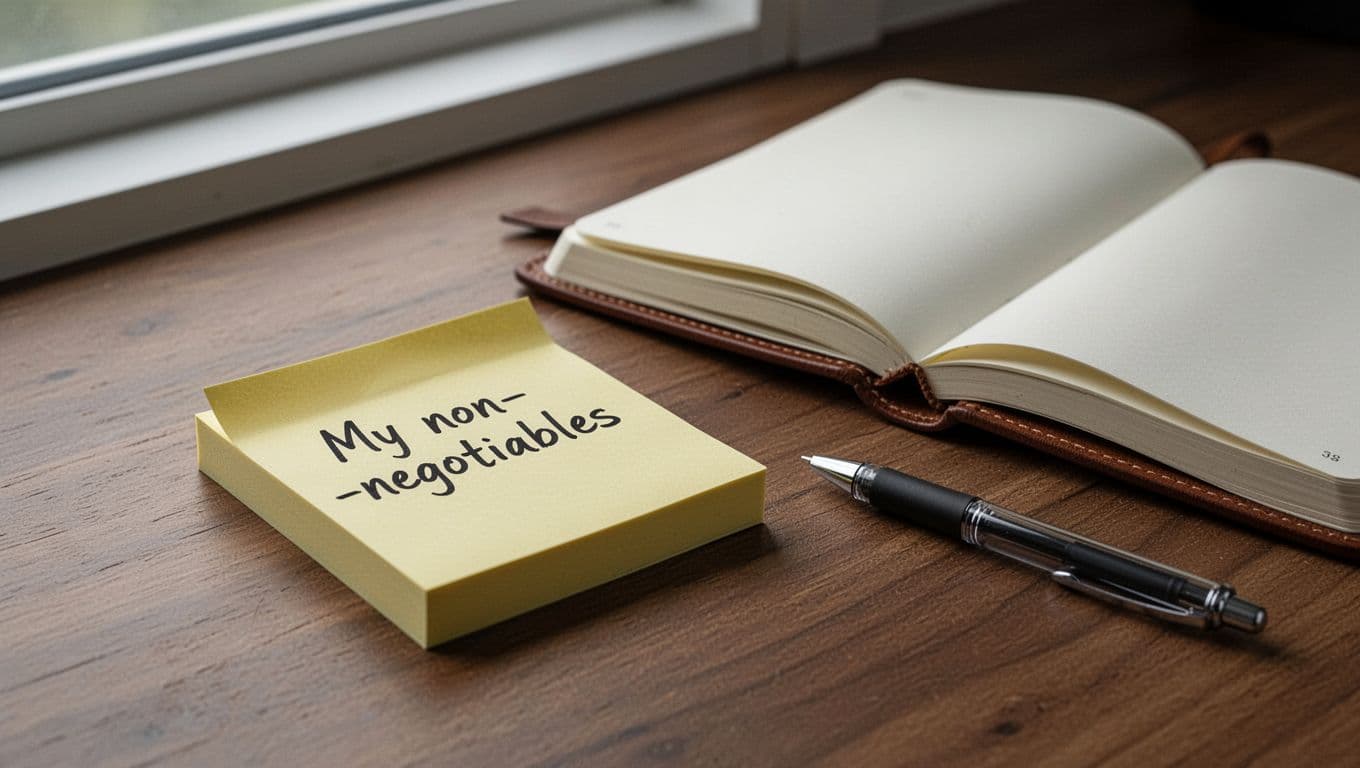 A sticky note of “non-negotiables” beside a journal
In midlife romance, boundaries are not buzzkills. They are proof she learned something. After divorce, a heroine’s “rules” are often the first form of self-trust she can hold onto. They create emotional safety, and safety is where chemistry can actually grow. When she knows she can say no without punishment, she can relax enough to feel desire again.
Boundaries also build attraction because they show clarity. A woman who can name what she needs is not “difficult.” She’s done bargaining with her own gut. And a good partner does not see her limits as a challenge to overcome. He sees them as instructions for how to love her well.
Simple, later-in-life boundaries that read as both realistic and romantic:
- She sets a slow physical pace, even if the connection feels electric.
- She asks to meet the kids later, not because she’s ashamed, but because she respects their world.
- She keeps separate finances, at least at first, because trust takes time.
- She draws a line around no late-night ex calls, unless it’s truly about the kids.
- She protects alone time, because solitude is part of her stability now.
The key is what happens next. A solid love interest responds with steady behavior. He checks in, he follows through, and he does not sulk. He might even offer his own boundaries, which makes the relationship feel like a partnership instead of a performance.
Show the romance growing because of those limits. He plans dates that fit her schedule. He texts earlier instead of later. He respects her “not tonight” and still makes her feel wanted tomorrow. That’s the kind of tenderness readers remember.
This is also where women’s fiction shines, because the relationship becomes a safe mirror. She sees herself clearly, maybe for the first time in years, and she likes what she sees.
For readers who love the “starting over” journey beyond romance alone, this boundary-building phase fits right alongside why midlife reinvention stories feel like therapy for women. It’s the same emotional promise, a woman can rebuild her life without abandoning herself.
The moment she chooses herself, the romance gets stronger
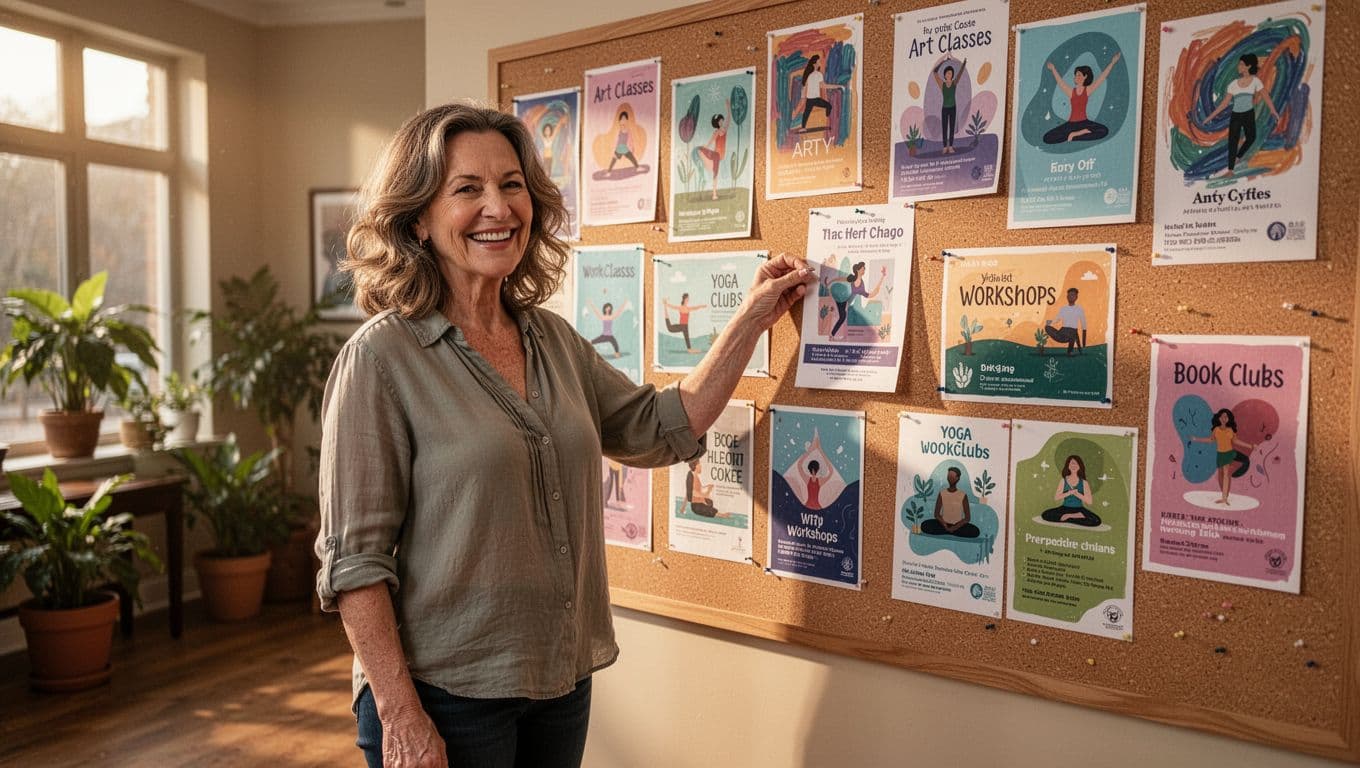 A woman pinning up a class flyer on a community board
The romance often deepens right after she makes a choice that has nothing to do with him. That is the “brave new yes” readers come for, not a yes to dating, but a yes to her own life. Instead of shrinking to keep peace, she steps forward and takes up space. As a result, love has something real to grow around.
These self-choice scenes work because they are active. She stops waiting for permission. She stops treating her needs like a negotiation. Most importantly, she learns that choosing herself does not make her unlovable. It makes her more herself, and that is what the right partner falls for.
Here’s a mini beat list of moments that show self-trust in motion:
- She says no without a long explanation, even when guilt flares.
- She asks for what she needs (time, clarity, affection, space) and stays steady while she waits.
- She pursues a dream she shelved, signing up for a class, applying for the job, renting the studio.
- She calls out disrespect in real time, instead of replaying it later in the shower.
- She accepts help without losing herself, letting him fix the porch light, or letting a friend pick up her kid, and not turning it into a debt.
Each beat sends the same message to the reader: she’s not being rescued. She’s participating. That is why women’s fiction with later-in-life romance feels uplifting. The love story is sweet, yes, but the deeper comfort comes from watching a woman rebuild her own backbone.
When she chooses herself, she stops auditioning for love. Then love finally has a fair chance.
Romance beats that feel fresh when the characters are older and wiser
Later-in-life romance after divorce feels freshest when it stops pretending love happens in a vacuum. These characters have calendars, commitments, and a past that left marks. So the best romantic beats stay grounded in everyday life, and still make your heart kick.
In women’s fiction, that grounded feeling comes from adult choices with real costs. A date isn’t “just a date” when childcare has to be arranged, gossip moves fast, and Monday morning comes whether you’re ready or not. That pressure makes even small moments, a glance across a room, a lingering text, a simple “I can pick that up for you”, feel charged.
Meet-cutes with adult stakes: real life is the third character
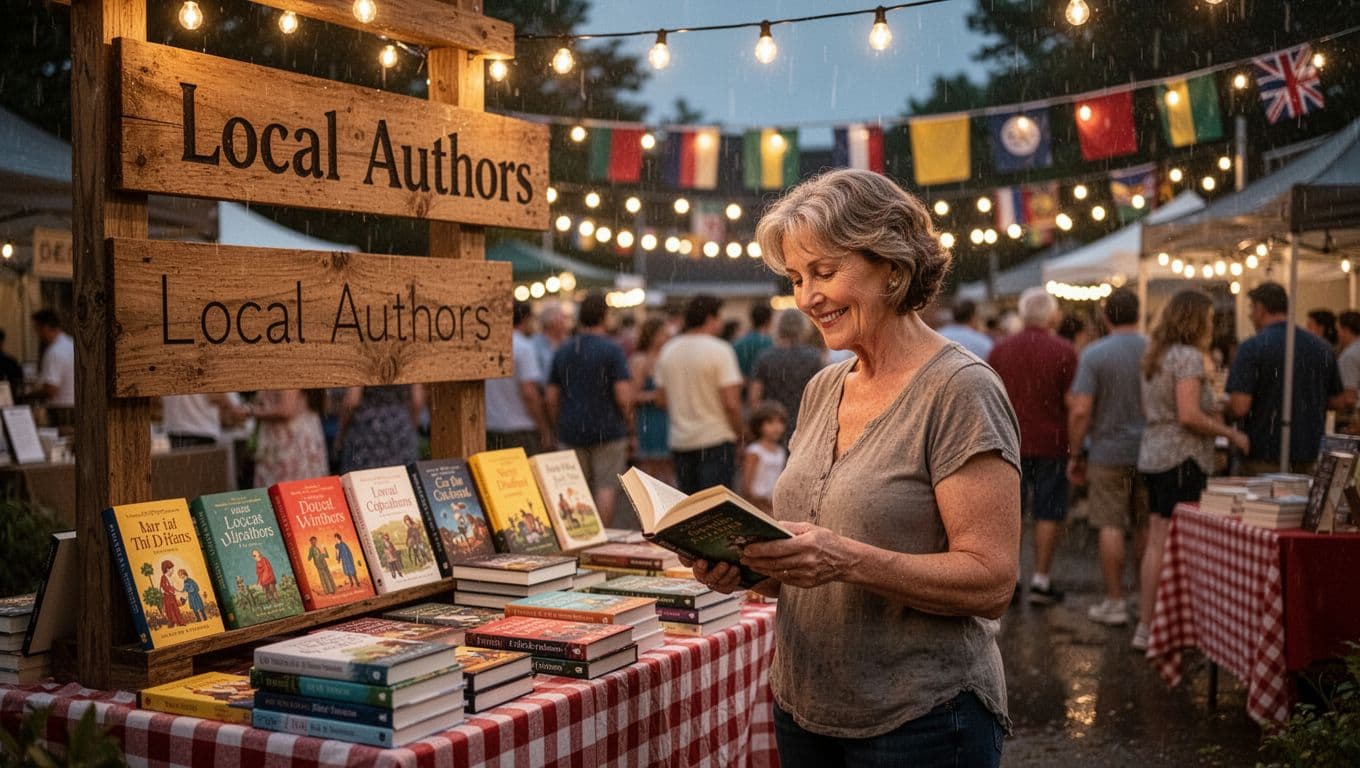 A small-town festival booth with string lights and a “Local Authors” sign
A meet-cute for a divorced heroine works best when it’s believable and a little inconvenient. Chemistry lands harder when it shows up in a place she can’t simply avoid. Even better, the setting should bring public visibility and real consequences, because grown-ups don’t only risk their hearts, they risk their peace.
Here are a few meet-cutes that fit older, wiser characters, and why they sparkle:
- Bookstore event (author talk or signing): She’s there to support a friend, not flirt. He asks a smart question, and she answers before she can stop herself. Adult stakes: her reputation matters, and her ex’s cousin is three seats away.
- PTA mix-up: She walks into the wrong meeting, or her name is on a volunteer list she never agreed to. He’s the calm one who untangles it. Adult stakes: school politics are intense, and her kid will hear about it by lunch.
- Volunteer shift (food pantry, shelter fundraiser, beach clean-up): They’re both there for reasons that say something about them. Adult stakes: she’s learning to accept help, and he sees her in “real life” clothes, not date-night armor.
- Neighbor renovation: A saw starts at 7:00 a.m., and she stomps over ready to fight. Instead, he apologizes, offers to fix the loose fence, and suddenly she’s talking about paint colors. Adult stakes: proximity raises the pressure, because home is her safe zone.
- Dog park: Their dogs tangle leashes, and they untangle the conversation. Adult stakes: she’s on a tight schedule, and her phone keeps buzzing with co-parenting logistics.
- Small-town festival: They get stuck running the same booth, or a rain shower pushes them under the same tent. Adult stakes: the whole town watches, and she hates being a topic.
- Wedding planning (friend’s wedding, adult child’s wedding): She’s helping, he’s the vendor or the best man, and both have opinions. Adult stakes: weddings stir up grief, and she’s determined not to cry in public.
- New job: He’s a client, a colleague, or the guy training her on systems she doesn’t want to learn. Adult stakes: she cannot afford messy workplace drama, especially now.
What makes these scenes feel fresh is the third character in the room: real life. Time limits, kids’ needs, and small-town visibility create friction that isn’t childish. The couple can like each other and still hesitate, because liking someone is easy, but rearranging a life is not.
A great later-in-life meet-cute doesn’t trap them together. It shows why walking away would cost something.
Slow-burn trust is the real tension

In later-in-life romance, the tension doesn’t need goofy miscommunication. It can come from something sharper and more honest: the fear of repeating old patterns. After divorce, the heroine often knows exactly how a charming beginning can slide into a lonely middle. So she watches for signs. She tests consistency. She tries not to, but she does.
That’s why slow burn works so well here. It’s not “will they kiss?” as much as “can she relax?” Attraction is the spark, but trust is the oxygen. Without it, the flame never holds.
Instead of dragging out the relationship with avoidable misunderstandings, build tension through trust steps. These are small scenes that show character, because grown-up love is proven in the boring parts.
A few trust-step moments that hit hard:
- He remembers her schedule without making it weird. Not in a grand gesture way, but in a respectful way, “Your week with the kids starts tomorrow, want a quiet night tonight?”
- He shows up consistently. Same tone, same kindness, even when he’s tired. That steadiness feels almost unreal to someone used to emotional whiplash.
- He handles conflict calmly. He doesn’t punish her with silence. He doesn’t turn every boundary into a debate. He listens, then responds like an adult.
- He respects privacy. No pressure to share divorce details, no fishing for gossip. If she offers the story, he holds it carefully.
- He’s safe with her children’s world. He doesn’t compete for attention. He doesn’t act like he’s “saving” them. He lets her lead.
To keep the slow burn from feeling stalled, let each trust step change her behavior. Maybe she stops over-explaining. Maybe she sleeps better. Maybe she asks for what she needs the first time, not the fifth. Those are romantic victories too.
Sensual scenes also shift when characters are older and wiser. They can be tender, confident, and still hot, because the heat comes from safety and attention. A later-in-life love scene doesn’t need acrobatics. It needs presence. The kind that says, “I see you, and I’m not going anywhere.”
Family, friends, and community make the love story feel bigger
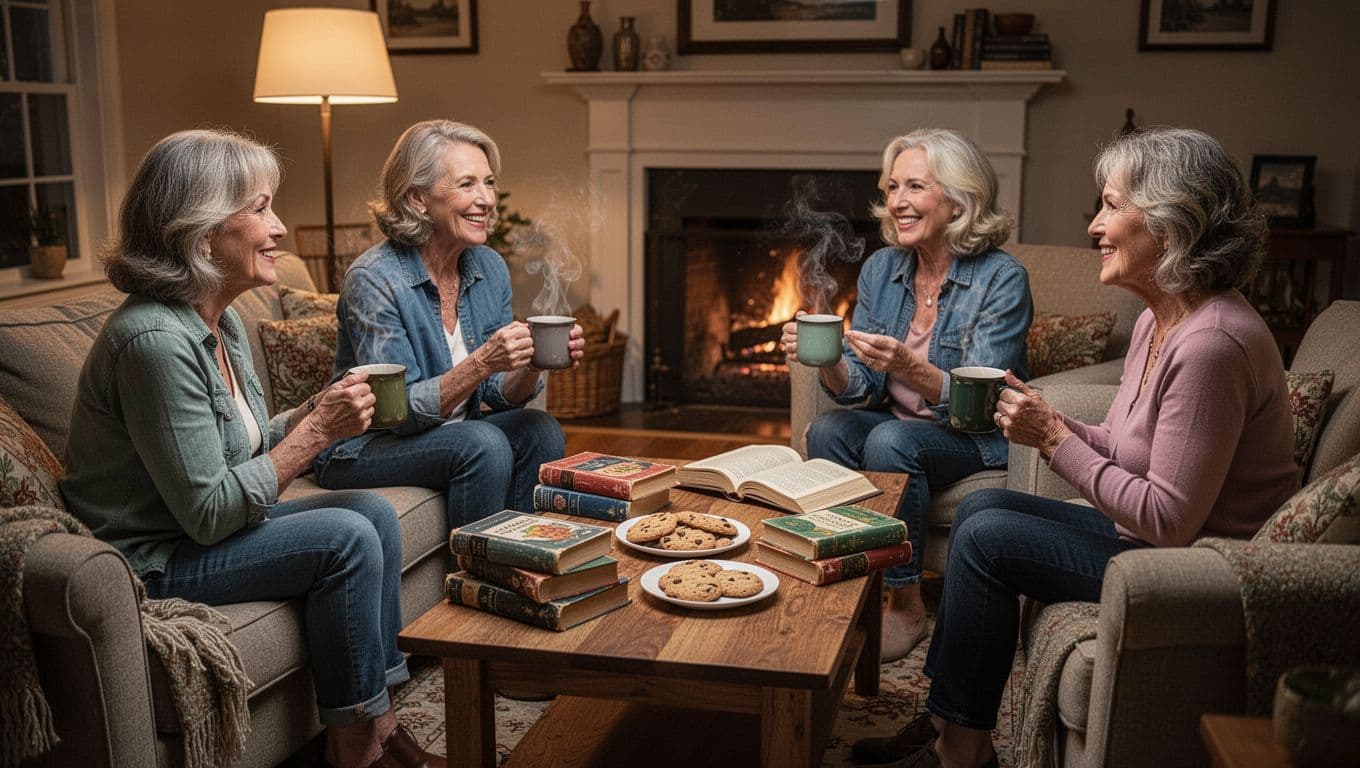 A living room book club circle with mugs and paperbacks on a coffee table
One reason women’s fiction romance feels richer than romance alone is the supporting cast. Love doesn’t only happen between two people, it happens inside a web of relationships. After divorce, that web might be frayed. So when the heroine builds it back, the romance feels bigger, not just sweeter.
Side characters can deepen the story in ways that feel true to later-in-life dating:
- Protective friends who want her happy, but fear she’ll get hurt again. They don’t hate men, they hate what pain did to her.
- Adult kids with opinions (and receipts). They might like him, distrust him, or simply hate change. Either way, their reactions raise the stakes.
- Siblings who remember the “before.” They can call out her people-pleasing, or remind her she used to laugh more.
- Book clubs and group chats that become a safety net. Friends are the chorus, the comic relief, and sometimes the voice of reason.
- Nosy neighbors who mean well, and still gossip. In small towns, privacy is a luxury item.
- Found family (co-workers, fellow volunteers, longtime friends). They witness her growth in real time.
The key is balance. Side characters should pressure the choice, not steal the spotlight. If a friend solves the big problem, the heroine loses her moment. If an adult child runs the plot, the romance can start to feel like a debate team.
A few simple ways to keep the supporting cast strong but contained:
- Give each side character one clear role (the protector, the realist, the comic friend, the skeptical kid).
- Let them have scenes with the heroine that reveal her blind spots, then step back.
- Use them to raise stakes with one clean line, not a ten-page lecture.
- Make sure the love interest earns his place by interacting well, but keep the emotional turning points between the couple.
When done right, community works like stage lighting. It doesn’t change the actors, but it makes every expression easier to see.
How to find your next later-in-life romance after divorce read (plus what to try next)
Later-in-life romance after divorce reads best when it matches your emotional bandwidth. Some days you want salt-air comfort and a steady, kind love interest. Other days you want a book that lets the heroine crack open, feel it all, then build herself back up.
Use the guide below like a menu. Pick your mood first, then pick your tropes, then double-check the content notes so you do not end up skimming through something that hits too close to home.
Know the vibe you want: cozy, beachy, funny, or deeper and tearjerky
 Beachy comfort vibes, ready for a fresh-start romance
Think of “divorce romance” like weather. You can love storms, but you do not always want to read one. A quick mood check saves you from starting the wrong book at the wrong time.
Here’s a simple choose-your-mood guide:
- Small-town coastal comfort: Look for beach towns, friendly neighbors, found family, and a romance that feels like a warm blanket. These often include gentle humor and a practical fresh start.
- Rom-com energy: Choose witty banter, awkward first dates, and “I can’t believe I’m doing this” dating moments. Great when you want a confident happily-ever-after without heavy emotional lifting.
- Angst and healing (deeper, tearjerky): Pick stories that sit with grief, betrayal, identity shifts, or long marriages ending. The romance still matters, but the emotional payoff comes from watching her rebuild self-trust.
- Blended-family focus: Go for books where kids, custody schedules, and school events shape the relationship pace. The best ones make the love story feel earned, not rushed.
- Second chance with an ex: Choose this when you want “we grew up” energy, accountability, and real change (not a redo of the old hurt). It can be hopeful, but it can also stir up big feelings.
- Fresh start with a new love: Perfect if you want the cleanest emotional reset. The ex may still exist, but the story stays focused on what’s next.
Before you commit, scan reviews for the stuff readers often care about but summaries skip. The big ones in this niche are cheating, heavy co-parenting conflict, grief (death of a spouse or parent), and spice level (closed door, open door, or explicit). One small check can save your whole reading weekend.
If you keep bouncing off books, it is rarely “you.” It is usually a tone mismatch.
A few titles that capture divorce, second chances, and grown-up love (2025 to 2026)
 Photo by Jill Wellington
If you want newer picks that fit the “grown-up love after a life shake-up” vibe, this list gives you a solid starting point. Keep it spoiler-light, and let the emotional promise guide you.
- Along Came Amor (Alexis Daria): A divorced teacher’s “just for fun” connection turns real, with family pressure and chemistry that does not play small.
- Sunk in Love (Heather McBreen): A newer title often shelved with second-chance and fresh-start romances, good if you want a modern, hopeful reset.
- The Bridge Back To You (Riss M. Neilson): A grown-up love story that readers are picking up for healing vibes and the idea of finding your way back to yourself.
- The Fortune Flip (Lauren Kung Jessen): A life-change romance with a bright, forward-moving feel, ideal when you want optimism with real adult stakes.
- The Wedding Bait (Adele Buck): Wedding season chaos plus a mature second chance setup, for readers who like humor with a side of “wait, this is real.”
- Gray Hair Don’t Care (Karen Booth): A confidence-forward, sexy, midlife-leaning romance pick when you want fun, heat, and a heroine owning who she is now.
- Role Playing (Cathy Yardley): Great if you like quirky, heartfelt connection, plus a romance that values companionship and shared interests as much as attraction.
- Promise Me Sunshine (Cara Bastone): A gentler, more emotional option when you want tenderness, steadiness, and a love story that feels safe to sink into.
If you are sensitive to certain topics (infidelity, high-conflict ex drama, or explicit scenes), skim a few top reviews before you buy. Newer releases can vary a lot in tone, even when the cover promises comfort.
Quick checklist for picking books like this without getting burned by the wrong tropes
 A fast way to spot tone and tropes before you commit
Later-in-life romance after divorce is a comfort read until it is not. The fastest fix is to shop with a quick filter, not just vibes.
Use this checklist before you hit “Buy”:
- Search for the right keywords in the blurb and retailer tags: “divorced heroine,” “fresh start,” “midlife,” “second chance,” “small-town,” and “found family.”
- Check the relationship type early: is it new love, second chance, or back-and-forth with an ex? That one detail changes the whole emotional ride.
- Skim reviews for tone words: “cozy,” “uplifting,” “funny,” “emotional,” “angsty,” “heartbreaking,” and “bittersweet” usually tell the truth.
- Watch for trigger clues reviewers mention without spoiling: cheating, custody battles, manipulation, grief, or addiction.
- Confirm the spice level (or at least the heat style). In this niche, it ranges from fade-to-black sweetness to explicit scenes.
One more thing helps set expectations: women’s fiction often balances romance with personal growth. You are not only reading “will they,” you are also reading “will she.” When you want pure romance beats, pick a romance-forward title. When you want a deeper rebuild, women’s fiction delivers the slow, satisfying emotional win.
Conclusion
Later-in-life romance after divorce works in women’s fiction because it tells the truth, love is better when it’s earned, not rushed. The best stories honor what she lost, then show her building something steadier, with boundaries she keeps, a life that fits, and joy that doesn’t require her to shrink.
Even when the chemistry is sweet, the real payoff is self-respect. She stops negotiating with red flags, chooses peace on purpose, and lets love meet her where she is. If you also enjoy romance that balances heart with real life, you might like what women love to read about in romance fiction and the quick clarity in is women’s fiction romance. For the healing side of the arc, these steps to discover new purpose after heartbreak pair beautifully with this trope.
Thanks for reading, share your favorite setup (coastal small town, slow burn, blended families), and the kind of heroine you want next.


