

Feel-Good Women’s Fiction: What It Is and What to Expect?

Some days you want a book that feels like a warm drink at the end of a long week, something that leaves you lighter, not wrecked. That’s where feel-good women’s fiction comes in.
In plain terms, it’s women’s fiction that tackles real life problems (heartbreak, family stress, career pivots, starting over) with a hopeful tone and a satisfying ending. The characters still face hard stuff, but the story won’t wallow; it makes room for humor, tenderness, and the steady sense that things can get better. You can expect emotional honesty without the gut-punch finish.
If you’re new to the category, it also helps to understand the bigger umbrella of women’s fiction and how it compares to romance, because the lines can blur. For a quick reset, this breakdown of women’s fiction vs romance fiction and this guide to the real difference will keep expectations clear.
In this post, you’ll learn what this genre is, what it isn’t (no misery marathon, no surprise tragedy), and how to spot it fast when you’re browsing. If you love coastal comfort reads, you’ll probably nod along with why beach-town fresh-start stories feel like therapy and even build your own reading ritual with beach read “therapy kit” gifts or bookish gift ideas for women’s fiction lovers. And if your comfort meter depends on the love story, you may also enjoy things women love to read about in romance, plus lists like romance novels with strong, competent heroines, romance books with plus-size FMCs, and best romance books with strong female leads.

What feel-good women’s fiction is (and what you can expect as a reader)
Feel-good women’s fiction is where real life meets real hope. You’ll get a woman-centered story about change, growth, and relationships, without the emotional punishment some books lean on. Think of it like a long exhale: honest about the hard parts, steady about the healing, and satisfying when you turn the last page.
If you want a quick way to sanity-check your expectations while browsing, try this: the heroine’s inner life drives the plot, and the story’s emotional direction stays warm, even when things get messy.
The heart of the genre: a woman facing change and finding her way
 One woman at a crossroads in a charming town, choosing what comes next
At the center of feel-good women’s fiction, you’ll usually find a woman in a season of change. Sometimes the change is loud (divorce, a move, a job loss). Other times it’s quiet but just as life-altering (an empty nest, a parent’s health decline, a friendship shifting, a wake-up call that she’s been living on autopilot).
The typical character arc isn’t “she becomes perfect.” It’s more like she becomes honest. She’s forced to update who she is, the way you finally update your phone after ignoring the notifications for months. The old version still exists, but it can’t run the new life anymore.
Common emotional beats you can expect:
- An identity shift: She’s no longer “the wife,” “the helper,” or “the responsible one,” and that’s scary at first.
- Second chances: Not always romantic, often personal (a return to a dream, a repaired bond, a braver choice).
- Learning to ask for help: Because independence is great, but isolation is heavy.
- Choosing herself: Not in a selfish way, but in a sane way.
This is why so many readers connect with stories about reinvention, including women’s fiction books about starting over after divorce. It’s also why character strength in this genre often looks like boundaries, honesty, and persistence, not action-hero vibes (see strong heroines in women’s fiction and why readers love emotionally complex strong heroines).
Romance may show up, and it’s often sweet and meaningful, but it’s not always the main engine. Plenty of feel-good women’s fiction is powered by friendship, family, self-respect, or a fresh start that finally sticks. For readers who do want love on the page without losing the heroine’s independence, romance books with strong independent female protagonists can be a great next stop.
For browsing ideas outside any one author, Goodreads lists like feel-good women’s fiction in cozy settings can help you find similar vibes fast.
The tone: uplifting, not perfect, and never hopeless
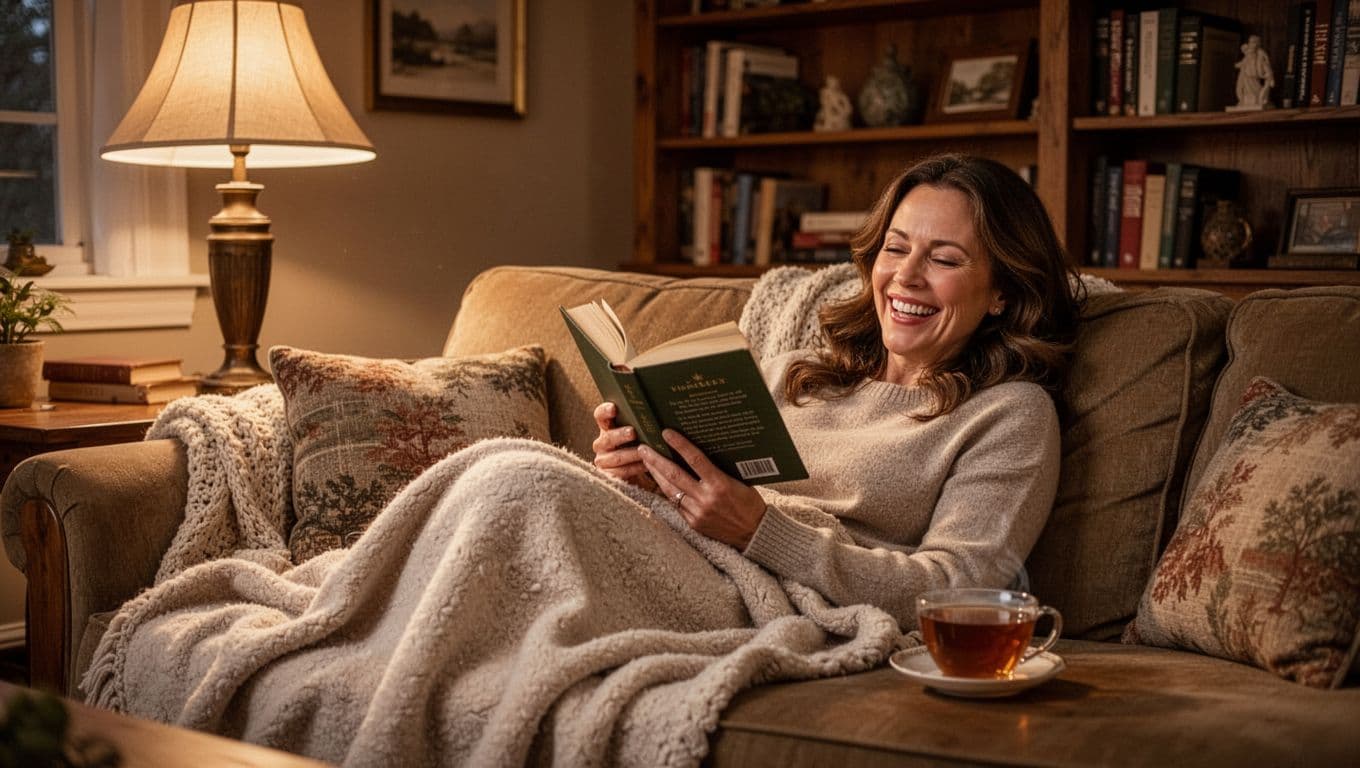 A cozy reading moment that matches the warm tone of comfort-forward fiction
“Feel-good” is a tone promise, not a plot promise. In other words, you’re not signing up for a story where nothing goes wrong. You’re signing up for a story where the hard stuff doesn’t swallow the whole book.
These novels tend to balance real emotions with warmth and humor. You might cry in chapter twelve, then laugh two pages later because a best friend says the one blunt thing everyone else is thinking. The humor isn’t there to erase pain, it’s there to make the pain survivable.
So what won’t you typically find in feel-good women’s fiction?
- Gratuitous cruelty that feels like shock value.
- A “misery marathon” where every chapter gets darker.
- Relentlessly bleak endings that leave you stranded emotionally.
That last point matters. Endings are a big deal in this subgenre because the reader is often coming in a little tender. They want the book to feel like a safe place to land. The ending does not need to tie up every loose thread, but it should deliver emotional payoff and relief. You close the book feeling steadier than when you started.
The best feel-good women’s fiction doesn’t deny pain, it refuses to let pain be the final word.
If you’re in a season where your own life feels wobbly, that kind of emotional safety can be powerful. It’s the same reason readers gravitate toward themes like rebuilding and forward motion, including steps to discover new purpose after heartbreak and the comfort of “try again” love stories (here’s why second-chance love stories feel like therapy).
For more mainstream browsing, curated roundups like Penguin Random House’s feel-good fiction recommendations can also help you spot the tone quickly.
The setting and “cozy cast” effect that makes the story feel like a hug
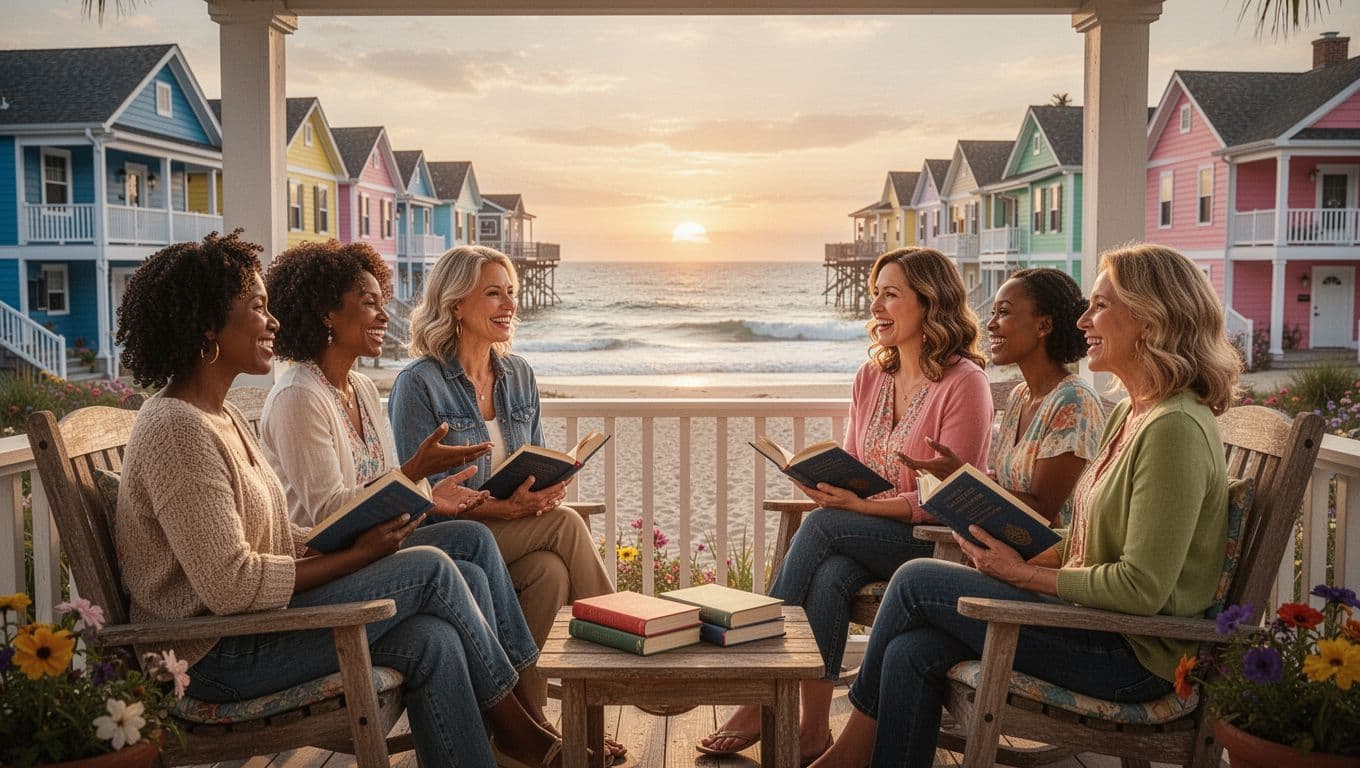 A book-club porch scene with ocean air and friendship at the center
A lot of feel-good women’s fiction is set in places that invite connection. You’ll see small towns, close-knit neighborhoods, beach towns, bookstores, cafés, and book clubs, basically any setting that makes it believable for people to run into each other, talk, and show up.
That’s where the “cozy cast” effect comes in. The side characters are often the comfort layer:
- The neighbor who notices everything (and brings soup anyway).
- The sister who says the hard truth with love.
- The older woman who quietly becomes a mentor.
- The friend group that argues, laughs, and still makes room at the table.
These supporting characters add comedy, warmth, and that hug feeling, but they also do something deeper: they make healing realistic. In this genre, community support is often part of the recovery, whether the heroine is rebuilding after divorce, grieving someone, or simply trying to figure out who she is now.
If you love that town-as-a-safety-net vibe, you’ll probably also enjoy the way coastal communities get written in comfort reads. A good companion piece is life lessons small coastal towns teach you, because it captures why these settings feel steady on the page. If you’re more of a beach-town reader, why women worldwide love beach stories nails the emotional pull behind salt-air fresh starts.
Even when a heroine feels isolated at first, the story often nudges her toward people, small gestures, and everyday rituals. A book club meeting. A volunteer shift. A local event she almost skips. Those scenes can feel simple, but they’re doing important work. They remind you that a new life is rarely built in one brave moment. It’s built the way a town gets rebuilt after a storm, one helping hand at a time.
And when you want stories that carry hope without feeling shallow, women’s empowerment themes can fit right into this space too, like the titles gathered in women’s fiction books about women’s rights. The tone stays humane, even when the stakes are real.
Key ingredients that make a women’s fiction story truly feel-good
The best feel-good women’s fiction is honest without being exhausting. It gives you real problems, real emotions, and a steady sense that the characters can handle what’s ahead. You’re not reading to escape life entirely, you’re reading to remember that life can be messy and still turn out okay.
Below are the story ingredients that tend to create that “lighter when you close the book” feeling.
A hopeful arc, with real stakes that stay readable
 One woman at a crossroads, facing change with a clear-eyed hope
A feel-good story still needs conflict, otherwise it reads like a scrapbook. The difference is meaningful conflict versus misery. Meaningful conflict pressures the heroine to make choices, grow up a little, and tell the truth. Misery piles pain on pain until the reader feels punished for caring.
Readable stakes often hit close to home. They’re the kind of problems you can picture happening to a friend, which makes every small win feel big:
- Saving a family business before the bank takes it, or before a big chain moves in.
- Rebuilding trust after a betrayal, a long-kept secret, or a breakup that left bruises.
- Starting a second career after a layoff, burnout, divorce, or an empty nest.
- Coming back home to deal with family tension, caregiving, or a parent’s house full of memories.
Authors keep tension high without making it heavy by controlling the emotional weather. The heroine might have a terrible day, but the book doesn’t stay stuck there. You’ll often see support systems, small humor beats, and forward motion on the page, even when she’s scared.
A helpful way to think about it is this: the story can get stormy, but it keeps a porch light on. If you like spotting these patterns across books, this guide to women’s fiction themes and tropes is a great companion.
In feel-good women’s fiction, the pain is part of the journey, but it’s not the destination.
Relationships that heal: friends, sisters, moms, mentors, neighbors
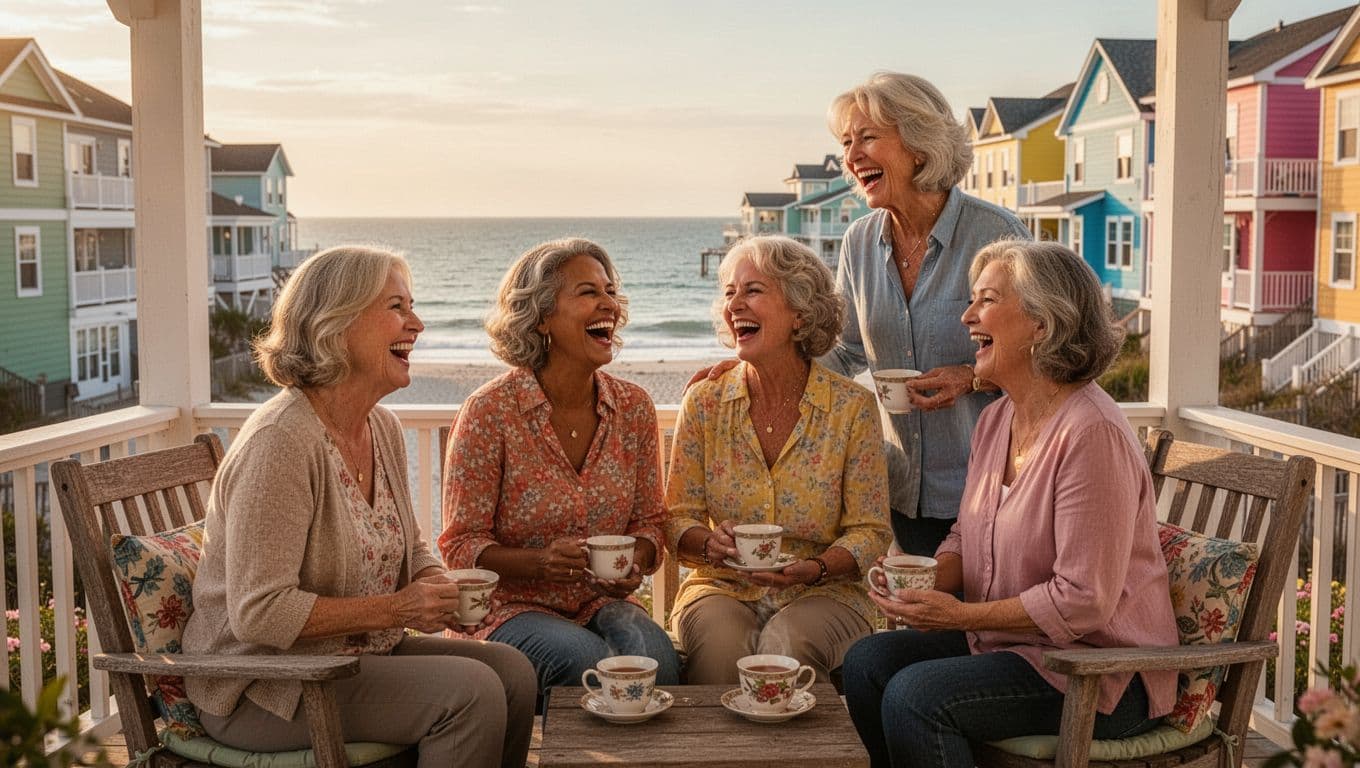 Friendship and community warmth in a beach-town moment
A lot of women’s fiction is powered by love, but not always romantic love. The real engine is often relationships that repair what life wore down. A sister who shows up after years of distance. A mom and daughter learning to talk like adults. A neighbor who becomes family because she simply keeps her word.
Feel-good doesn’t mean everyone gets along. In fact, the bonds that land hardest are usually the complicated ones. You might see:
Forgiveness with limits. The heroine can forgive, but she doesn’t hand out unlimited access to her life.
Boundaries that stick. She stops explaining herself to people committed to misunderstanding her.
Chosen family. When blood ties are messy, community ties can be the safe place.
Friendship that survives conflict. The best friend messes up, apologizes like a grown-up, and does better.
These stories often treat relationship growth like learning a new rhythm. At first, everyone steps on each other’s toes. Then they adjust. They listen. They try again.
If you want a relationship-forward list of strong, memorable women you can root for, start with strong heroines who define modern women’s fiction. It’s a great way to find character arcs built on grit, heart, and hard-earned connection.
Humor and small joys that feel earned, not forced
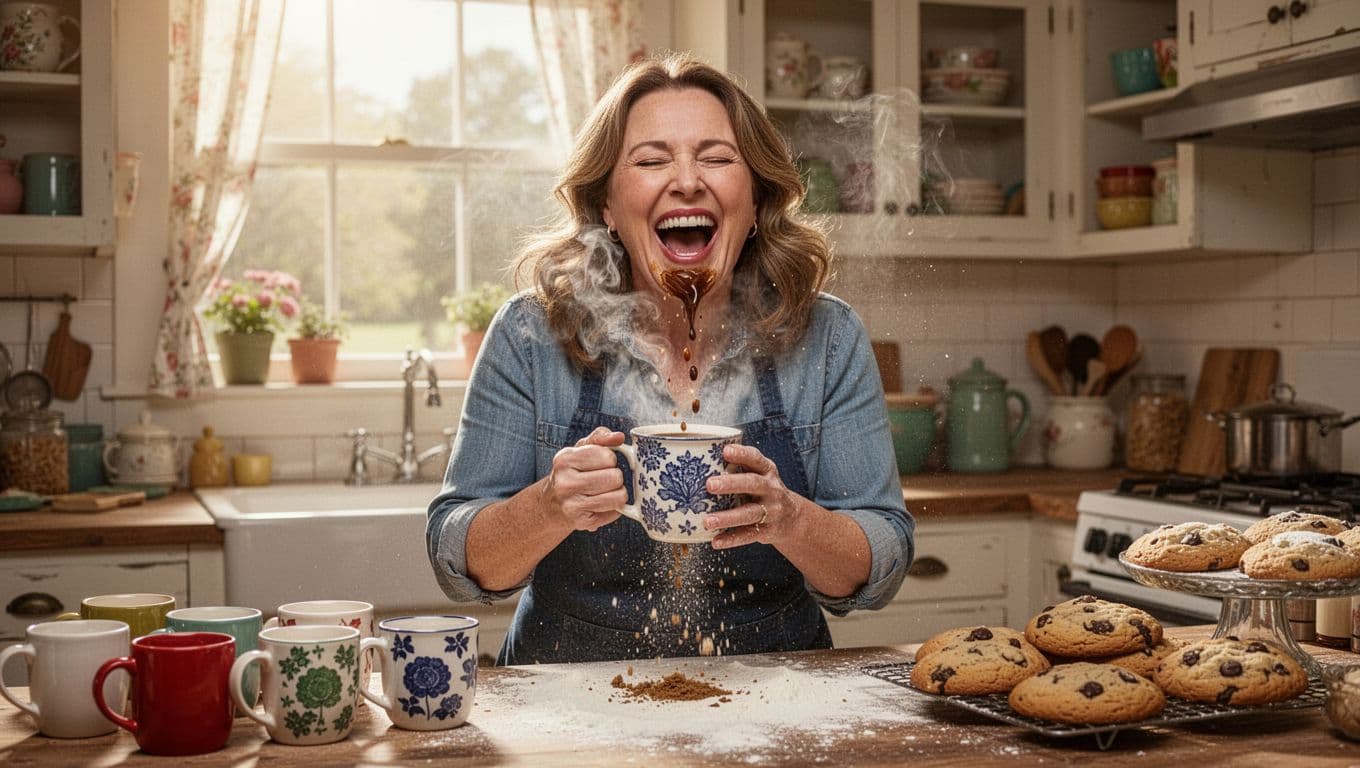 An everyday mishap that turns into a real laugh, not a performance
In truly comforting books, humor isn’t a stand-up routine. It’s a release valve. It comes from voice, quick banter, and the kind of everyday chaos that makes you laugh because you’ve lived it.
The funniest moments often show up right next to the hard ones, which is exactly how real life works. You can be stressed about money and still lose it laughing because the smoke alarm won’t stop yelling at you.
Common feel-good humor beats include:
- A bad first date that goes wrong in a normal way (too much talking, not enough listening).
- A work mishap that’s embarrassing but survivable (reply-all disasters, wardrobe malfunctions).
- Quirky locals who mean well and overstep anyway.
- A best friend who tells the truth, but not gently.
What makes these small joys feel earned is that they don’t erase the problem. They sit beside it. The heroine still has to face the hard conversation, pay the bill, apologize, or start over. She’s just laughing while life is messy, which can be oddly comforting on the page.
For readers who like their comfort reads with steady warmth (and plenty of heart), publisher roundups like Penguin Random House’s feel-good fiction list can be a useful way to find similar tones across authors.
A satisfying ending that leaves you lighter (even if it’s not a fairy tale)
 Emotional closure that feels calm, clear, and earned
A “happy ending” in feel-good women’s fiction usually doesn’t mean fireworks and perfection. More often, it means emotional closure. The heroine may not get everything she wanted, but she gets what she needed to breathe again.
A satisfying ending can look like:
- A new direction: she chooses the job, the town, the dream, or the next step.
- Emotional peace: she stops chasing approval and starts trusting herself.
- Repaired relationships: not every relationship, but the ones worth saving.
- A solid sense of self: she can name what she wants, and she’s not sorry about it.
Romance can absolutely have a happy ending too, but it’s often a “plus one,” not the only win. The deeper payoff is personal growth: the moment you realize she won’t abandon herself again.
If you want to browse what’s coming next in this space, lists like anticipated women’s fiction releases for 2026 can help you spot that hopeful tone before you commit.
How feel-good women’s fiction compares to romance and other women’s fiction
Genre labels matter because they set your expectations. Pick up a romance, and you’re signing up for a relationship-centered ride. Pick up feel-good women’s fiction, and you’re usually following a woman as she rebuilds, rethinks, and reclaims her life, with love as one thread in a bigger tapestry.
If you’ve ever finished a book and thought, “That was satisfying, but not in the way I expected,” this comparison will help. The differences aren’t about “better” or “worse,” they’re about what drives the story and how you feel after.
Feel-good women’s fiction vs romance: when love is the bonus, not the whole plot
Romance novels make a clear promise: the love story is the main event, and the ending delivers a committed relationship (often a happily ever after, or at least happy for now). Everything else supports that center lane, the family drama, the job stress, the small-town secrets, all of it feeds the couple’s arc.
Feel-good women’s fiction often includes romance, sometimes a lot of it. However, the core engine is usually her life journey. The biggest question is not “Will they end up together?” It’s “Will she finally choose a life that fits?”
That shift changes what comfort looks like on the page:
- In romance, comfort often comes from certainty. The reader knows love will win, even if it gets messy first.
- In feel-good women’s fiction, comfort often comes from stability and growth. You watch her build a safer life, one honest choice at a time.
A quick “shelf test” can help when you’re browsing: if removing the romantic partner would collapse the entire plot, you’re probably in romance territory. If the story still works because her friendships, family ties, and self-respect are the real spine, you’re likely in feel-good women’s fiction.
For a thoughtful look at how love stories can shape what we expect off the page, see how romance novels shape real love expectations.
Romance is a spotlight on “us.” Feel-good women’s fiction is a lantern, it lights up her whole life.
Feel-good women’s fiction vs general women’s fiction: the difference is the emotional aftertaste
Women’s fiction is a wide umbrella, and not all of it is soothing. Some stories are hopeful. Others are bittersweet, heavy, or even dark. The themes can be similar across the board (marriage strain, grief, motherhood, identity), but the emotional aftertaste is where the split shows up.
Feel-good women’s fiction aims to uplift without lying to you. The story can still hurt, but it won’t leave you stuck in the pain. Instead, it tends to offer:
Emotional depth without emotional exhaustion. You get real stakes, but the book doesn’t punish you for caring.
Repair, not just rupture. Relationships might break, but someone tries to fix what matters.
Forward motion. Even in rough chapters, you can feel a path opening.
This is why feel-good women’s fiction works so well for readers who want to cry a little, laugh a little, and close the book feeling steadier. It’s the difference between “I’m glad I read that” and “I need to stare at a wall for an hour.”
If your favorite kind of catharsis involves starting over and finding solid ground again, you’ll probably connect with novels about divorce that feel like therapy and the hopeful pull of midlife reinvention stories for women over 40.
For an outside perspective on how readers and writers define the category, this overview of what women’s fiction is is a helpful reference point.
Feel-good women’s fiction vs cozy mystery or book club fiction: similar comfort, different engines
Cozy mystery and feel-good women’s fiction can both feel like a soft place to land. They often share small towns, quirky side characters, and a sense of community. Still, they run on different fuel.
A cozy mystery is puzzle-driven. The plot motor is the case, the clues, the suspects, and the satisfying click when it all makes sense. Character growth can be there, but the mystery stays in the driver’s seat.
Feel-good women’s fiction is growth-driven. The plot motor is her decision-making, her healing, and the relationships that change because she changes.
Book club fiction is trickier because it’s more of a “discussion style” than a strict genre. It often overlaps with women’s fiction, and sometimes it overlaps with feel-good. Yet plenty of book club picks lean intense, tragic, or morally thorny on purpose, because the point is debate.
So if you want comfort, don’t rely on the label alone. Look for tone cues: warmth on the page, supportive relationships, and an ending that feels like a deep breath. If you want a discussion-heavy story, book club fiction might fit. If you want a brighter emotional landing, feel-good women’s fiction is the safer bet.
If you’re still sorting out where your current read sits, this guide on women’s fiction vs romantic comedy can also help clarify tone and pacing.
Popular themes and trends readers are loving right now
 A comforting stack of feel-good reads in a bright, coastal-style space
Feel-good women’s fiction keeps shifting with what readers need most. Right now, the stories that hit hardest tend to do two things at once: they tell the truth about real life, and they still leave you with that steady, hopeful feeling in your chest.
Across book clubs, beach bags, and bedtime reading, a few themes keep popping up, because they give you emotional payoff without asking you to suffer for it.
Starting over stories: divorce, career pivots, and fresh starts that feel possible
 A fresh start moment, confident, grounded, and hopeful
There’s a reason “starting over” is having such a moment in feel-good women’s fiction. Reinvention is satisfying to read because it turns the messiest parts of life into a story with shape. You watch someone lose the old identity, then build a new one with her own hands, like rebuilding a porch after a storm, plank by plank.
Divorce arcs, especially, tend to land when they focus on reclaiming confidence, not “winning” the breakup. The best versions don’t pretend it’s easy. They show the awkward firsts (first solo grocery run, first holiday, first time saying “my place”), and then they give you the payoff: she stops shrinking.
Career pivots hit that same nerve. A heroine who walks away from burnout, or finally tries the thing she wanted at 22, feels like permission. Even if your life looks nothing like hers, the emotional math still works. Fear plus action equals momentum.
If you love this trend, you’ll probably also like how these books lean into the inner shift, the moment she realizes she’s been living on someone else’s rules. That’s why lists like women’s fiction books about starting over after divorce stay popular. They scratch that itch for a clean page and a believable next chapter.
The most comforting fresh starts aren’t dramatic. They’re practical, brave, and repeatable.
Friend-group novels and small community stories you wish you could live in
 An ensemble cast moment, warm friendships, shared laughter, and real connection
Friend-group novels work because they give you the “hang out with these characters” feeling. Plot still matters, of course. Yet the real pleasure is the steady rhythm of scenes that feel like real life: group texts, late-night kitchen talks, porch debates, and the friend who brings snacks because she doesn’t know how to show love quietly.
Ensemble casts also make emotional healing feel more believable. When the heroine struggles, she isn’t magically fine by chapter twelve. Instead, she gets nudged forward by people who notice, people who annoy her into honesty, people who stay.
Small community stories take that comfort one step further, because community acts like a character. The town has habits. It has gossip. It has a “mayor’s-wife energy” woman who knows everything. It also has a way of pushing people into each other’s lives, which is exactly what a lonely heroine needs.
In feel-good women’s fiction, the community often provides:
- Low-stakes belonging (book clubs, volunteer events, local cafés)
- Accountability with affection (someone calls you out, then hugs you)
- A soft landing (help offered without a long speech)
If that’s your favorite flavor, the coastal version of it can be especially soothing. There’s a reason readers keep gravitating toward stories where place and people work together. For a quick companion read, life lessons small coastal towns teach you captures that “I want to live here” pull.
A little twist of magic or nostalgia, still grounded in real feelings
 Nostalgia with a hint of magic, intimate, emotional, and grounded
A clear trend right now is light speculative touches in otherwise emotionally realistic stories. Not epic fantasy, not complicated world-building. Think time travel, sliding-doors moments, or a gentle “what if?” that cracks the character open.
It works because the magic is rarely the point. The point is what the heroine learns when the story gives her a second look at her past, or a glimpse of a different path. That’s feel-good women’s fiction at its best: it changes the angle, not the emotional truth.
Nostalgia is part of this wave, too, especially 80s and 90s references used like emotional shorthand. A cassette tape, a mall memory, a high school yearbook, these details can feel like a scent that brings a whole version of you back in one breath. When it’s done well, it’s not gimmicky. It’s a way to talk about aging, regret, and identity without turning the book heavy.
A couple examples readers are already watching:
- Kate Quinn’s The Astral Library, which centers on a portal into beloved book worlds while staying focused on a woman’s personal turning point (see the publisher listing for The Astral Library).
- Rebecca Serle’s Once and Again, a title that signals the kind of “second chance at a moment in time” hook many readers love (see Once and Again on Google Books).
The sweet spot is simple: the story can bend reality a little, but it still respects the heart. The feelings stay true, even if the plot gets a touch enchanted.
A small dash of magic can make the emotional lesson land harder, because it shines a brighter light on what we already fear, want, and miss.
Conclusion
Feel-good women’s fiction is character-driven women’s fiction that faces real-life problems with warmth, forward motion, and a satisfying, hopeful emotional landing.
If you want a quick way to spot it before you commit, use this checklist:
- Tone: tender, funny in places, and never mean for sport
- Arc: she grows through the messy part, then makes a clear choice that changes her life
- Relationships: friends, family, neighbors, or chosen family show up and matter
- Ending promise: relief, closure, and a sense she will be okay, even if everything is not perfect
Next, pick one book based on your mood. If you want comfort and community, choose a small-town or coastal setting. If you want a stronger emotional release, choose a fresh-start story with a bigger life pivot. Then give it 50 pages to do its job.
Thanks for reading, if you have a favorite feel-good women’s fiction title, what scene made you exhale and think, “Okay, life can get better”?


