

When Tropes Start Writing The Story for You

A trope is a familiar story pattern, like fake dating, enemies-to-lovers, or the big third-act breakup, the thing that helps readers know what kind of ride they’re on. I love tropes for that reason, they’re a promise. Still, I’ve watched tropes start making choices for my characters, and suddenly I’m not writing a story, I’m following instructions.
It usually starts innocently. I’ll set up fake dating, then I catch myself hitting the same beats on autopilot: the “we need ground rules” scene, the forced hand-hold, the jealous flare-up, the public almost-kiss, like I’m working through a checklist instead of letting the relationship breathe. If you’ve ever rolled your eyes at the most annoying romance tropes to avoid or yelled along with the miscommunication trope in romance, you already know how fast a pattern can turn into a rut.
In this post, I’m talking about how to tell when a trope has grabbed the steering wheel, why it happens (especially when I’m trying to write what readers crave, like the 13 things women love in romance fiction), and how I take my story back without losing the comfort of the familiar. I’ll also connect the dots between romance expectations and women’s fiction patterns, using guides like women’s fiction themes and tropes, romance subplot vs main plot, what is women’s fiction, and women’s fiction vs romance.
Because the goal isn’t to ditch tropes. It’s to keep the parts readers love (hello, grand gestures in romance fiction) while making sure my heroine still has agency, the kind I want in strong heroines in women’s fiction and strong independent heroines.

Tropes are tools, not a plot: what they do well (and where they go wrong)
I love tropes for the same reason I love a familiar beach-town boardwalk, I know where the best stops are. Tropes help me promise a feeling fast, which matters in romance and women’s fiction, where readers come for emotional payoff. Still, I can’t let a trope decide every turn for me, because a signpost isn’t the whole trip.
Early 2026 reader chatter still circles the same heavy-hitters (like enemies-to-lovers, fake relationships, and forced proximity) because they reliably deliver tension and comfort in one package. That popularity is a clue, not a command.
Why readers love familiar tropes in romance and women’s fiction
 An emotionally cozy reading moment by the shore
Familiar tropes create emotional safety. They tell readers, “You’re in good hands,” even if the characters still have work to do. That safety is why so many of us re-read comfort authors when life feels loud, and it’s also why trope-heavy blurbs get quick clicks.
They also create quick buy-in. In a few words, a trope answers the reader’s biggest questions: What kind of tension is this? How will it hurt, and how will it heal? When I say “second chance,” the reader expects shared history and unfinished feelings. That same expectation shows up in why second-chance love stories feel like therapy, because the emotional promise is built in.
I think of tropes as clear expectations, not a scene list. Here are a few that fit my readers (and why they work so well):
- Second chance romance: It promises history, regret, and the chance to do it right this time.
- Friends to lovers: It signals tenderness and trust, plus that “it was always you” ache (and if you like seeing this done with fresh character types, romance books with Black female leads is a great browsing lane).
- Forced proximity: It creates pressure without needing a villain, which is why it shows up in everything from “snowed in” to “stuck renovating a house.”
- Grumpy and sunshine: It’s emotional contrast on purpose, and when it’s done with care, it reads as safety, not cruelty (especially when the heroine has real agency, like the kind discussed in best romance books with strong female leads).
- Small-town fresh start vibes: It offers community, belonging, and a slower pace, which is exactly why beach-town fresh-start stories soothe so many readers.
A trope, at its best, is a shortcut to emotion. It points toward the experience, then my characters still have to earn it scene by scene.
A trope can open the door, but character choices are what make readers stay.
When a trope becomes a cage: the hidden cost of writing by formula
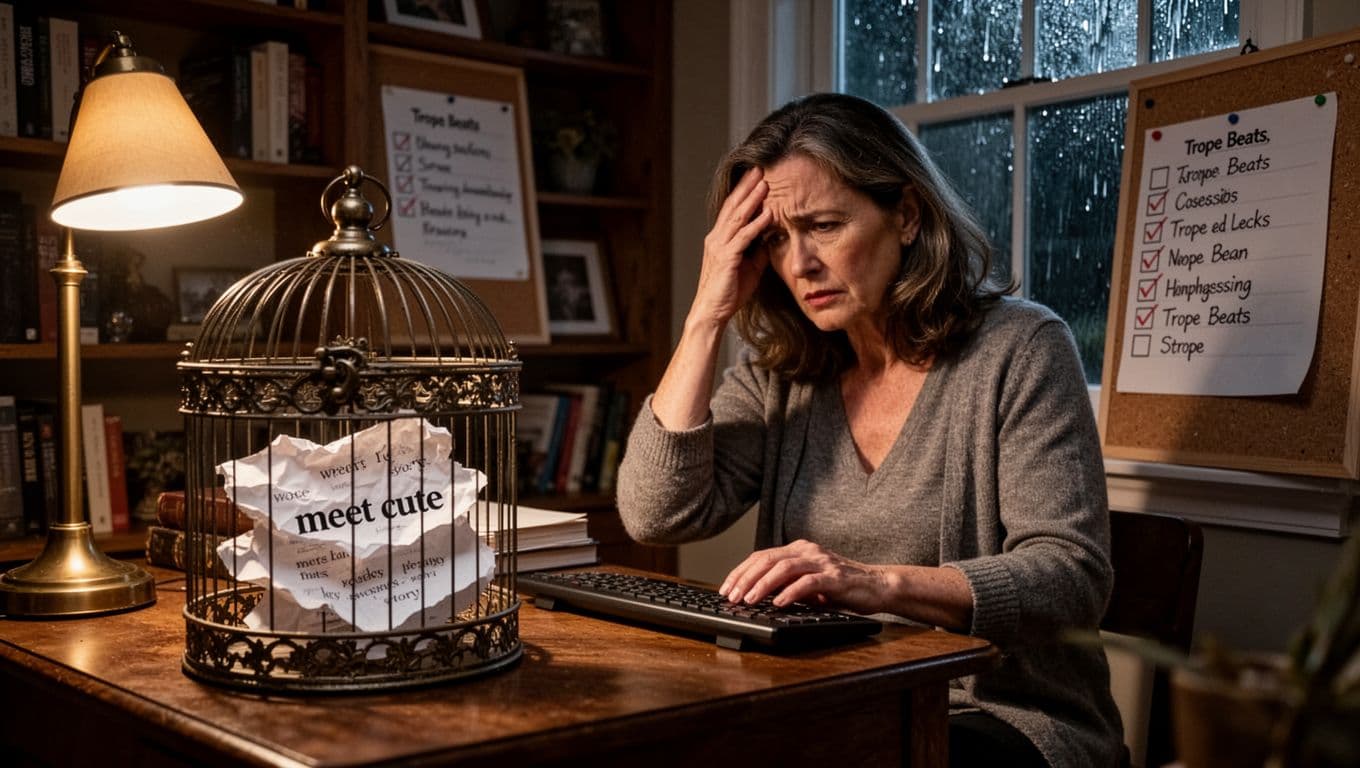 A writer feeling boxed in by expectations
The trouble starts when I write scenes because I think I’m “supposed” to. If every chapter hits a known beat, the story can feel pre-solved. Readers might keep turning pages, but they don’t feel surprised, and the ending lands softer.
Here’s what I notice when trope turns into a cage:
Predictable scene sequencing. The couple argues on schedule, softens on schedule, breaks up on schedule. It can start to read like paint-by-numbers romance.
Flat characters. If a trope is doing the emotional work, my leads stop doing it themselves. The “grumpy” becomes one-note. The “sunshine” becomes a smile machine. Real people have weather.
Rushed feelings. Formula can push the relationship forward faster than the characters’ trust would actually allow. That’s when love reads like a switch flip, not a change.
Conflicts that exist only because “the trope requires it.” This one is the biggest giveaway. The conflict doesn’t grow from who they are, it gets stapled on.
Mini-example (because I’ve seen this a hundred times): Enemies to lovers where the “enemy” reason is silly, like he once took her parking spot in college. Then, after two snarky conversations, they’re soulmates by page 60. The tension feels fake, and the turn to love feels unearned.
If I want tropes to stay helpful, I have to keep asking: Would my character do this if I wasn’t aiming for a trope moment? If the answer is no, I’m writing by template.
That’s also why I’m picky about which tropes I read when I want comfort versus stress. Some readers love high-stakes chaos, others want gentle pressure. You can see how wide that range is inside “comfort tropes” like pregnancy romance, where the same setup can be cozy or intense (see romance books with pregnancy, plus the more specific guide to accidental or unexpected pregnancy romances).
Trope vs. premise vs. theme: the quick clarity check
 A simple visual way to separate pattern, plot, and meaning
When I feel trope-creep happening, I do one fast check. It keeps me honest, and it’s easy to skim.
Here’s the test:
- Premise is what happens.
- Theme is what it means.
- Trope is the familiar pattern I might use to deliver it.
A coastal small-town romance example in one sentence each:
- Premise: A burned-out event planner returns to her coastal hometown to save her aunt’s struggling inn and ends up working with her first love.
- Theme: Coming home doesn’t mean going backward, it can mean choosing yourself with clearer eyes.
- Trope: Second chance + small-town fresh start, with some forced proximity because they’re stuck renovating the inn together.
If I can’t name my premise and theme without mentioning the trope, that’s a warning sign. It usually means I’m building a story-shaped container, not a story with a spine.
This is also where genre expectations matter. Romance readers often want the couple’s arc centered, while women’s fiction readers want the heroine’s wider life change centered. When I’m straddling that line, I revisit how I personally sort it (and why it affects pacing) in women’s fiction vs romantic comedy.
One last gut-check I use: if I remove the trope label, do I still have a compelling story? If yes, I’m free. If no, the trope is writing me. And I don’t want that.
How to tell the trope is writing your story (before readers do)
I can usually tell a trope has grabbed the steering wheel when my draft starts feeling a little too smooth. The scenes still “work,” but they work the way a canned laugh track works. The emotional beats land on time, yet nothing feels earned.
When that happens, I stop asking, “Is this a popular trope?” and start asking, “Is this my story, or a rerun?” Here are the early warning signs I watch for, before a reader ever gets the chance to say, “I saw that coming.”
Your characters start acting like “types” instead of people
 A grumpy and sunshine pairing that looks more like labels than layered people
This is the fastest way I know a trope is writing for me. My cast stops surprising me, because they stop being human. They become stickers I slap onto scenes.
I see it in small, repeatable “type behavior,” like:
- The grumpy lead only grunts, glowers, and says no to everything, even when it makes no sense.
- The sunshine lead only jokes, even in moments that should hurt.
- The heroine loses her backbone so the hero can look strong, wise, or protective.
- The best friend exists only to push the ship, meaning every line is “Just text him!” or “You’re so in love!”
The real giveaway is that their choices stop costing them anything. The grump never risks tenderness. The sunshine never risks anger. The heroine never risks being wrong, or being the one who walks away.
A simple fix that always helps me reset: I give each lead three private anchors, then I rewrite with those in mind.
- A fear they hide (even from themselves).
- A desire they can’t stop wanting (even when it’s inconvenient).
- A line they will not cross (even for love).
Once those are in place, the trope becomes flavor again, not a personality transplant.
You can predict the next scene because you have seen it in ten other books
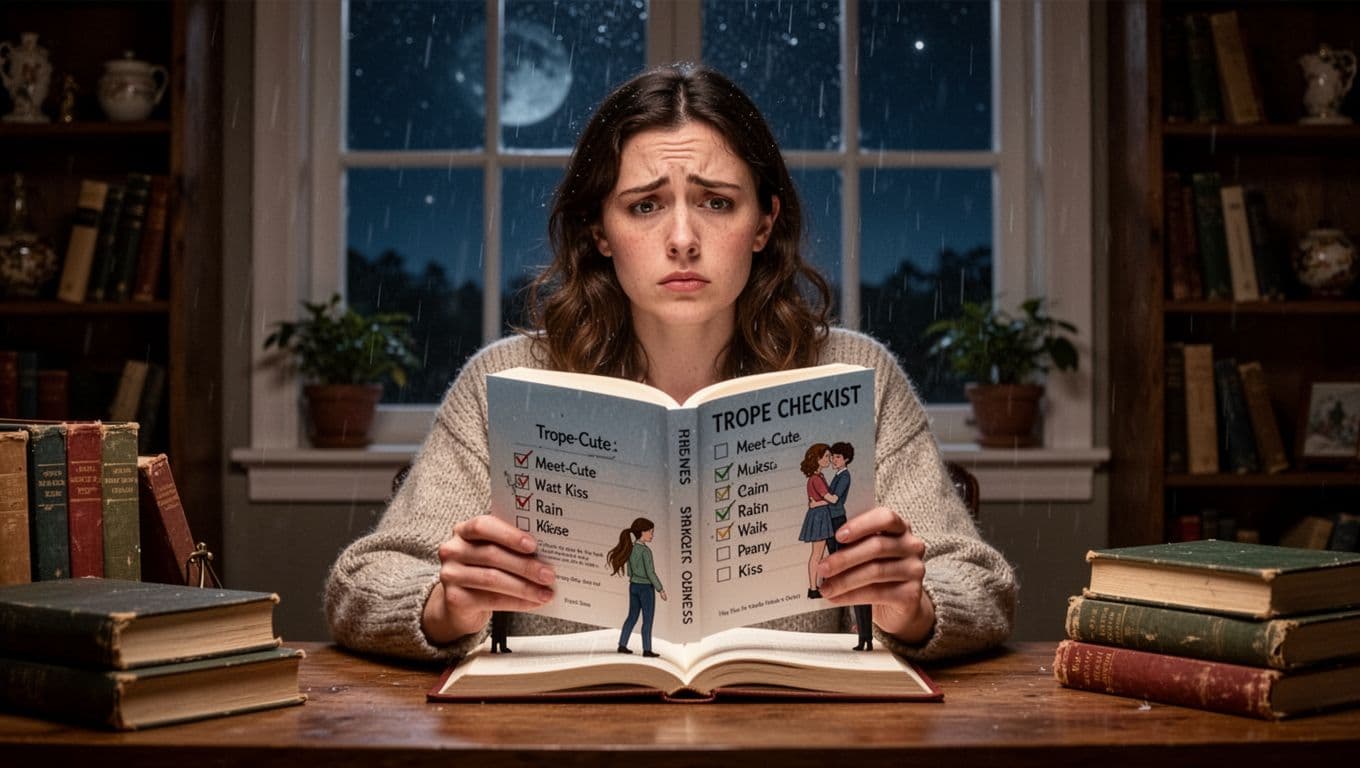 A writer watching familiar romance beats play out on cue
Sometimes the problem is not the trope, it’s the order of operations. When I’m writing on autopilot, my draft starts lining up like a greatest-hits album:
Meet-cute, check. One bed, check. Rain kiss, check. Third-act breakup, check. Grand gesture, check.
None of those beats are bad. I love them when they come from character pressure and story logic. The trouble starts when they happen because I can hear an invisible director calling, “And now we do the rain scene.”
Here’s the question I use when I suspect I’m doing “checklist beats”: What story-specific reason forces this moment right now? If I can’t answer in one clean sentence, I’m probably borrowing structure instead of building it.
Then I do what I call the swap test:
If I can swap the character names with two other leads, and the scene still works, the trope is driving.
A rain kiss should not survive a cast swap. It should only work because these two people, with this history, made this risky choice in this exact moment. If the scene feels interchangeable, I don’t cut the trope first. I cut the convenience.
The conflict feels fake, or it vanishes the minute someone speaks honestly
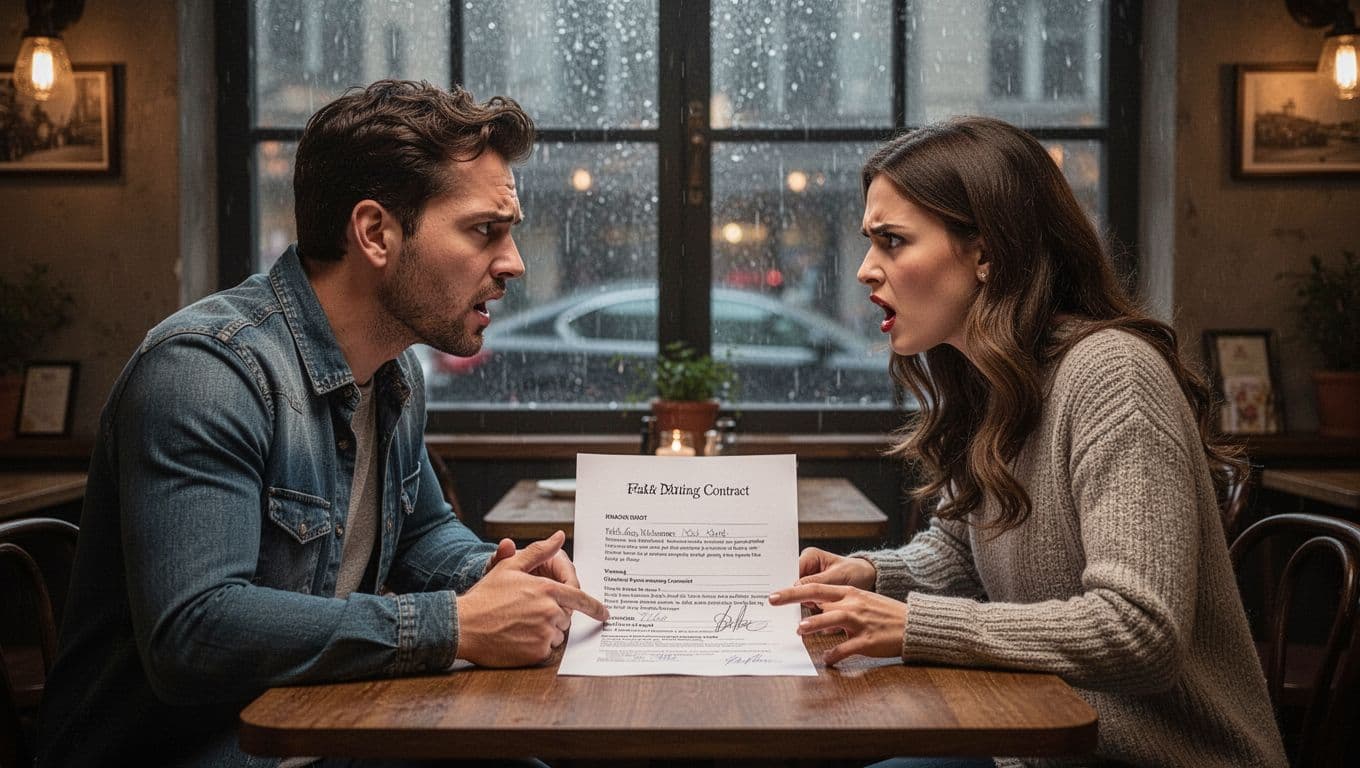 A couple stuck in an argument that could end with one honest sentence
A trope-driven draft often has conflict that behaves like fog. It rolls in to create mood, then disappears as soon as anyone turns on a light. That’s usually a sign I’m using manufactured misunderstandings.
Manufactured misunderstanding looks like this: two capable adults refuse to ask one basic question, because the plot needs them to stay upset. It can also show up as coincidence overload, where “bad timing” keeps doing the heavy lifting.
A concrete romance example I’ve seen (and written, if I’m not careful): fake dating that keeps going long after it stops being necessary. The characters could admit the truth to the friend group, the boss, the ex, whoever, but they keep performing the lie because the trope wants another forced-proximity scene.
When I catch that, I try to trade “fake” conflict for conflict that has teeth:
- Values clash (what they believe is right, even when it hurts).
- Past wounds (what love used to cost them).
- Family pressure (real obligations, real consequences).
- Real stakes (jobs, custody, reputation, community trust, a dream that took years).
If honesty would fix everything in 30 seconds, the problem is not tension. It’s that I haven’t given them a reason to fear the truth.
You keep adding more tropes to fix the boredom, and it gets louder, not better
 A writer realizing the draft is being pulled around by trope strings
When a story feels flat, my first impulse is to add sparkle. Another trope. Another twist. Another “big moment.” That’s how trope stacking happens.
Suddenly it’s fake dating plus love triangle plus secret billionaire plus surprise inheritance plus only one bed. The plot gets busy, yet the emotional center gets buried. Instead of momentum, I get noise.
The problem is that stacking tropes can turn my story into performance. The pages start shouting, “Look, I did the thing you like!” Readers can feel that. They might not name it, but they sense when a plot is performing instead of moving.
My simple rule is this: add depth before adding another trope.
So I ask myself:
- Did I deepen the leads’ wants, or did I just raise the volume?
- Did I make the choice harder, or did I just make the setup wilder?
- Did I complicate the relationship, or did I decorate it?
When the answer is “decorate,” I back up. One grounded, character-shaped problem will beat five flashy trope add-ons every time.
Why this happens: the psychology of trope autopilot
When I slide into trope autopilot, it isn’t because I’m lazy or uncreative. It’s because my brain likes to conserve energy, and story patterns are pre-made paths. Tropes tell me what to do next, which feels soothing when I’m tired, rushed, or trying to hit a daily word count.
The problem is that the same shortcut that helps me draft can also flatten my characters. Autopilot writes “a romance,” not this romance. So I watch for the spots where my brain is choosing the familiar over the true, then I steer back toward what my characters actually want.
Tropes are a shortcut for the brain, especially when you are drafting fast
 Writing fast can make familiar scenes feel like the easiest next step
Drafting is a constant decision factory. Who speaks first? What do they avoid? What detail makes this moment feel real? After a few hours, my brain starts begging for anything that reduces choices. Tropes do that beautifully. They are mental autocomplete.
That’s why, when I’m drafting in a rush, I grab “known scenes” like they’re a granola bar in my bag. Only one bed. Forced proximity. The elevator stops. The cabin has one room. These scenes arrive with built-in tension, so I don’t have to invent tension from scratch.
Decision fatigue turns trope beats into a default setting, because familiar patterns:
- lower the number of plot options I have to weigh,
- create instant pacing (a scene that “goes somewhere” fast),
- give me a clear emotional target (awkward closeness, accidental intimacy, jealousy).
Still, a shortcut has a cost. If my characters haven’t earned that level of closeness, the scene reads like a costume party. I can almost feel the reader thinking, “Wait, why are they acting like this already?” That’s when I remind myself that trope comfort is not the same as character truth.
When I want a quick reset, I stop and ask: What pressure exists here without the trope? Sometimes it’s family expectations. Sometimes it’s grief. Sometimes it’s pride. In women’s fiction especially, the pull usually lives in the heroine’s inner weather, which is why I keep coming back to the appeal of layered strong female leads when I’m revising.
If my draft keeps reaching for chemistry tricks, I also look at whether I’ve given my lead real agency. A trope cannot replace a heroine with a spine, and I keep that straight by revisiting key insights on heroine agency.
You are writing to the trope’s promise, but forgetting your characters’ promise
 The trope moment versus the character moment
A trope makes a promise to the reader, but each main character also makes a promise to me. That promise is emotional, not mechanical. It’s what they want, what they fear, and what they need to learn before love can stick.
When I forget the character promise, I start writing to the trope label instead. I write “second chance romance,” and I hit the hits: the reunion, the lingering stare, the old nickname. Yet the real story might be something tougher and more tender: forgiveness, trust, and accountability.
Here’s the character-first version I aim for in second chance:
- What they want: not just each other, but peace, stability, a future that doesn’t repeat the past.
- What they fear: being fooled again, being the fool, being unlovable once the shine wears off.
- What they need to learn: trust is built in small repairs, not one big speech.
In other words, “they used to date” is only the wrapper. The center is, “Can I believe you will treat me differently now?” That’s why I like checking myself against the way romance can train our brains to look for scripted proof. The article on how tropes shape our love scripts helps me notice when I’m trying to prove love with a flashy moment instead of consistent change.
I also keep a file of heroines who don’t let the trope do the heavy lifting. When I need that reminder, I peek at romance novels with strong heroines. Competence on the page creates natural conflict, because capable people still make messy choices, just with higher stakes and sharper consequences.
When I honor the character promise, the trope starts supporting the story again, instead of replacing it.
Trend pressure and social media advice can turn stories into templates
 Trend noise can make a writer’s brain cling to familiar beats
Trend pressure doesn’t just affect marketing. It can creep into the actual draft, especially when my feed is full of “must-have beats” posts and rapid-release talk. Then I start fearing that a quiet chapter, a strange choice, or a personal theme will make the book harder to sell.
Right now, reader chatter still rewards certain familiar setups. Enemies-to-lovers keeps pulling attention. Fake dating stays huge, often paired with only one bed. Grumpy and sunshine continues to rise. Sports romance remains strong, because it bakes in proximity and ambition. Slow burn holds steady, while love triangles trend down unless they feel emotionally safe. Instalove stays divisive.
None of that is evil. It’s information. The trap is treating trend info like an outline.
I try to use trends as packaging, not the product. That means I can describe the book in trope language, while keeping the inside specific. Social media pushes “tropes-first” discovery hard, and I’ve found it helpful to understand that pressure without letting it boss me around. The post on BookTok’s viral impact on romance books nails why books get sold as moments, not just stories.
Here’s how I protect my draft from becoming a template:
- I pick one trope promise I can deliver cleanly.
- Then I write one sentence for each lead that has nothing to do with the trope.
- Finally, I choose scenes that force those two sentences to collide.
If I’m still tempted to chase what performs, I re-center on what I want the reader to feel when they close the book. Comfort matters, but so does honesty, which is why I like revisiting the comfort of romantic fiction happy endings without ignoring the weird pressure that comes with “perfect beats.”
And when I’m writing women’s fiction with romance threaded in, I remember that a fresh start does not need to look trendy to be powerful. I keep that in mind with stories like the ones in women’s fiction on post-divorce fresh starts, because personal and specific almost always outlasts whatever the algorithm is shouting about this month.
Taking your story back without losing the trope readers came for
 A writer reclaiming control of her draft
When I realize a trope is steering, I don’t throw it out. I re-assign it. The trope becomes the stage lighting, not the script. Readers still get what they came for (tension, sweetness, that deep exhale at the end), but my characters stop moving like they’re hitting marks.
The trick is to protect the emotional promise while rebuilding the why underneath it. That’s where a story starts feeling personal again, even if I’m using familiar ingredients.
Start with character choices: the trope should bend to them, not the other way around
 A couple making a high-cost decision together
When my draft feels like it’s on rails, it’s almost always because my characters aren’t choosing enough. Or they’re choosing “easy,” which reads as safe on the page but empty in the chest.
So I start with a simple method that forces agency: I write five decision moments before I worry about trope beats.
Here’s how I do it in one sitting:
- I pick five points in the story where each lead must choose.
- In each moment, they choose something that costs them.
- I write the consequence in one blunt sentence: What breaks, changes, or becomes harder now?
- Only then do I map trope beats around those choices, like draping garland after the tree is standing.
The “cost” is the magic. It can be external (money, a job, a relationship with a parent) or internal (pride, control, a belief they’ve used as armor). Either way, the choice leaves a mark.
A quick example: if I’m writing forced proximity, I don’t start with “they get stuck together.” I start with, “She chooses to take the contract to keep her mother’s house,” or “He chooses to stay and help because he can’t stand being the man who leaves.” Now the proximity isn’t a gimmick, it’s a receipt.
This is also why strong, active protagonists make tropes feel fresher. Competence creates problems because capable people still want things badly, and they still mess up. If you like seeing that energy done well, I keep lists like strong heroines defining modern women’s fiction bookmarked because those characters don’t wait around for the plot to happen.
If a character’s choice doesn’t change anything, it’s usually a trope beat in disguise.
Keep the trope, change the reason: make the setup personal and story-specific
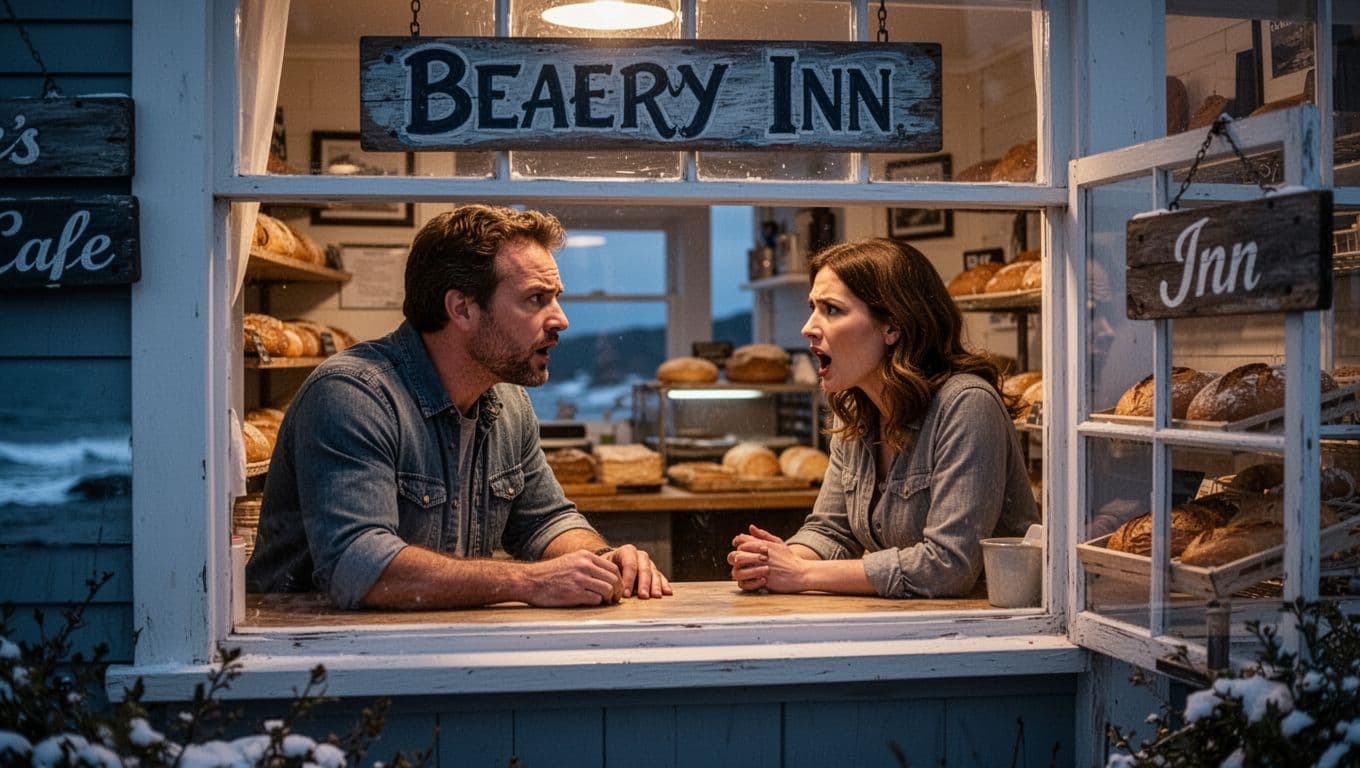 A couple tied together by real responsibilities
Sometimes the trope isn’t the problem. The problem is the engine powering it. If the setup feels random, the whole book can feel random, even if the scenes sparkle.
So I keep the trope readers want, but I swap in a personal, story-specific reason that could only belong to these characters.
Here are two “same trope, different engine” examples I lean on:
- Forced proximity, but not because of a random snowstorm. Instead, they’re co-running a family business because the grandmother’s health is failing and the town is watching. They can’t walk away without paying a social price.
- Fake dating, but not to make an ex jealous. Instead, they’re protecting a child’s sense of stability at a school fundraiser because gossip already hit the kid once this year.
In both cases, the trope is still there. Readers still get proximity and performance and tension. However, the reason underneath has roots. It pushes on identity, family, pride, or fear. It also gives me better scenes because it naturally introduces secondary characters who matter.
When I’m unsure what reason fits, I look at theme first. Theme is the filter that tells me what “counts” as pressure. If my theme is about belonging, the forced proximity should come from community, not weather. If my theme is about self-trust, fake dating should come from a boundary she needs to protect, not a petty plot.
I keep women’s fiction themes and tropes handy for that exact reason, because it helps me connect the romance setup to the bigger life change. A trope can be familiar, but the motive should feel like a fingerprint.
Twist the expected scene, not the emotional payoff
 An intimate moment without the standard setup
I remind myself that most readers aren’t collecting scenes, they’re collecting feelings. They want the tension, the relief, the safety, the sense of being chosen. They don’t need the exact same “only one bed” choreography every time.
That’s freeing, because it means I can twist the expected scene while still delivering the emotional payoff readers came for.
Four twists I reach for:
- “Only one bed” becomes “separate rooms, one honest conversation.” The intimacy comes from truth, not blankets. They sit on different beds, door open, and finally say the thing.
- Enemies-to-lovers includes a real apology. Not a half-sorry. A full, specific, accountable apology that costs the apologizer something (ego, reputation, a comfortable lie).
- The big jealousy flare-up becomes protective clarity. Instead of a public fight, one lead quietly admits, “I don’t like how it felt to watch you get dismissed.”
- Third-act breakup becomes a third-act teamwork problem. They don’t split. They fail together, then figure it out together. The relationship still gets tested, just not with a separation button.
This is where reader expectations get loud, especially around overused beats. If you’ve ever had strong feelings about the miscommunication mess, you already know the pain point, and the one romance trope we all yell about puts words to why “because the plot says so” conflict makes readers mad.
My personal rule is simple: I won’t remove the emotion. I’ll remove the autopilot. If I can make a familiar payoff happen in a way that only my characters would attempt, the trope stops feeling like a template.
Build stakes beyond the couple so the romance has something real to push against
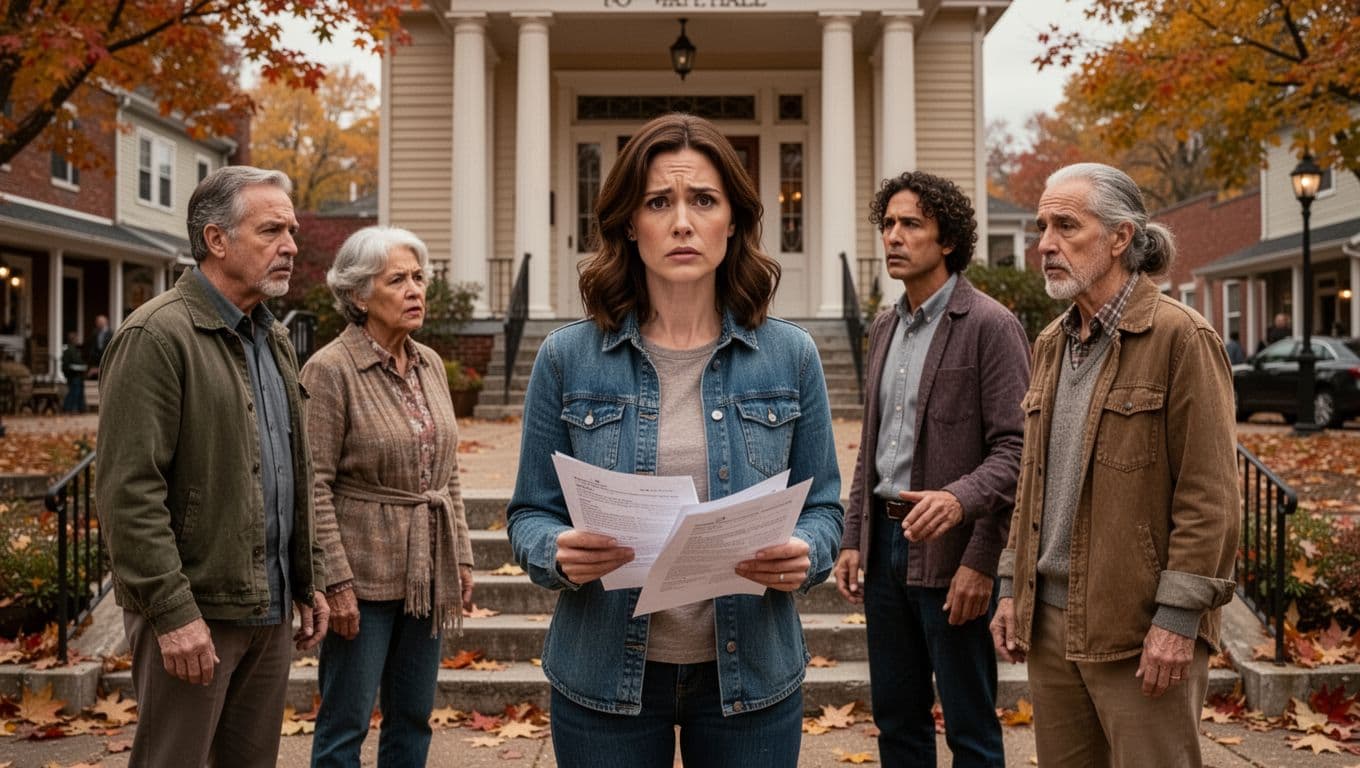 Outside pressure that makes the love story feel grounded
When the trope becomes the whole plot, everything starts to feel thin. The fix is not “more romance scenes.” The fix is outside stakes that force the couple to make harder choices.
This matters a lot in women’s fiction and small-town romance because community, history, and responsibility naturally press in. The romance gets stronger when it has something real to push against, like waves against a pier.
Stakes I use often (because they create consequences beyond hurt feelings):
- Caregiving: a parent’s decline, a sibling’s addiction recovery, a niece who needs stability.
- Career pivots: she’s rebuilding after burnout, he’s deciding if he can stay in town without shrinking.
- Community pressure: gossip, reputation, church-lady side eye, town council politics, family legacy.
- Identity and belonging: biracial identity, class tension, being the newcomer, being the one who left.
- Grief: not as decoration, but as a daily presence that changes how love is received.
- Friendship rifts: the best friend who feels abandoned, the sister who won’t forgive last year.
Outside stakes also stop me from using the trope as a conflict vending machine. Instead of “they can’t be together because reasons,” it becomes “they want each other, but if they choose wrong, a whole life collapses.”
Pregnancy-related tropes are a clear example where outside stakes make the story feel respectful and real. The best versions treat pregnancy as a life change, not a trap, and they make room for mixed feelings, practical concerns, and consent. If I’m writing in that lane, I look at the range of tones in pregnancy romance books, from comfort reads to high stakes so I match the vibe to the story I’m actually telling. For readers who prefer the surprise setup, accidental or unexpected pregnancy romances can be a good checkpoint for how other authors keep agency on the page. And when identity is part of the couple’s real-world context, I’m careful to write with specificity and care, the same way thoughtful lists like interracial pregnancy romance books spotlight.
Do a “trope audit” revision pass: keep what serves the story, cut what does not
Drafting is where I fall in love with tropes. Revision is where I make sure they earn their rent.
When I do a trope audit, I’m not asking, “Is this scene fun?” I’m asking, “Is this scene necessary, and is it mine?” Here’s the checklist I use when I want the story back in my hands:
- First, I highlight every trope-coded scene (the “rules” talk, the jealousy pop, the almost-kiss, the breakup-shaped moment).
- Next, I write the purpose in one line for each. If I can’t name the purpose, it’s probably filler.
- Then I confirm cause and effect. Did something happen that forced this scene, or did I drop it in because the trope expects it?
- After that, I confirm character change. Who leaves the scene different, and how?
- I remove duplicates. One “we can’t do this” scene can be powerful. Three is usually fear in a trench coat.
- Finally, I add one surprise rooted in character. Not a random twist, just a choice that reveals who they are under pressure.
That last step is where familiar tropes start feeling new again. Specific perspective changes everything. A fake dating plot with a plus-size heroine who’s done being treated like a novelty will not play the same as the standard version, which is why I love browsing lists like best romance books with plus-size heroines when I want a reminder that desire on the page should feel grounded and adult. The same goes for stories led by women whose voices and experiences shift the center of gravity, and fresh love stories with Black female leads is a great example of how a familiar setup can still feel specific and alive.
I end the audit with one question, and it never lies:
If the trope label disappeared, would I still care about these people?
If the answer is yes, I keep the trope and tighten it. If the answer is no, I cut until the characters show up again.
Conclusion
Tropes are a reader-friendly entry point, especially in romance and women’s fiction, because they promise a certain feeling. Still, when I let the “right” beats take over, my characters stop making real choices, and the story starts feeling pre-solved. The fix is simple, even when it’s not easy, I put character back in charge, then I let the trope follow.
Here’s what I come back to when a draft starts running on rails:
- I name the premise and theme without using trope labels.
- I force costly choices, then I build scenes from the fallout.
- I keep the trope, but I change the engine so it’s personal.
- I twist the expected moment, while keeping the same emotional payoff.
- I cut duplicate “trope-coded” scenes until every beat earns its page.
Thanks for spending time with me here, if you’ve felt that autopilot pull, you’re not alone. Pick one current project, name the trope, then write one scene that breaks the expected beat while keeping the emotional promise.


